
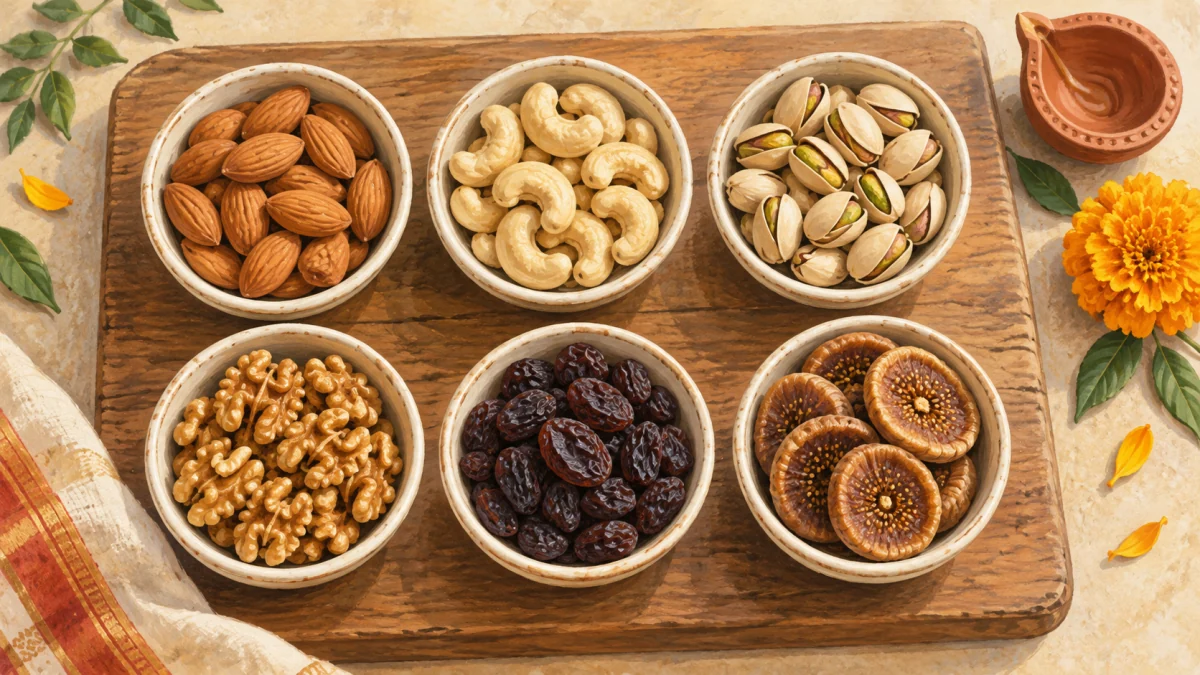
Dry fruits are the Diwali gift that rarely gets passed on. They suit almost every diet and age, they keep for months, and they get used up at exactly the time of year when the house is full of guests and someone in the kitchen is making kheer or ladoos for the third time that week. If you are stuck on what to give someone, dry fruits are the safe answer, unless you know they have a nut allergy.
What usually goes wrong is quality: the dusty packet from the back of the shelf, the “premium” box that turns out to be mostly raisins. This guide covers how to judge each of the common dry fruits, what the grades on the packet mean, how much to give, how to present them, and how the recipient should store them.
Why dry fruits are the safe gift
- No allergen surprises beyond nuts themselves, which are easy to ask about. No dairy, no gluten, no sugar unless added.
- No spoilage worry. Six months at room temperature in a sealed pack.
- Usable, not decorative. They go into the morning soak, the kheer, the ladoo, the guest bowl.
- Welcome for elders, who receive far more sweets than they can eat.
- Neutral for corporate gifting. No religious content, no assumptions about the recipient.
Judging quality, nut by nut
Almonds (badam)
Whole, uniform in size, skin intact and unwrinkled, no dark spots. Snap one: it should break cleanly with a crisp sound, and the inside should be white to pale cream. A bendy almond has absorbed moisture; a yellow interior is old. Bitter taste means rancid oil. “Mamra” almonds (from Iran or Afghanistan) are smaller, oilier and pricier; California almonds are larger and the standard for gifting.
Cashews (kaju)
Cashews are graded by size and wholeness. W means whole; the number is how many nuts make a pound. W180 is the largest (and most expensive), W240 large, W320 the standard “large whole” for gifts, W450 smaller. Pieces are graded separately (splits, butts, pieces) and are fine for cooking but not for gifting. A good cashew is ivory, uniformly curved, with no dark patches or shrivelling. Broken or bitty cashews in a “whole” pack means poor sorting.
Pistachios (pista)
Sold in shell (roasted and salted, for snacking) or shelled (raw, for sweets and cooking). In shell, the shell should be naturally open, pale, and the kernel green to purple-green. Closed shells are immature. Shelled pistachios should be bright green; dull olive means age. Iranian and Californian are the common origins; Iranian are smaller and stronger in flavour.
Walnuts (akhrot)
Usually sold shelled as halves and pieces. Halves are pricier and better for gifting. Good walnut kernels are light tan, plump, not shrivelled, and taste mild and creamy. Bitterness or a paint-like smell means rancidity, which walnuts develop faster than any other nut because of their oil. Buy from a shop with turnover; check the packing date.
Raisins (kishmish)
Golden (sultana) or black. Plump, soft, slightly sticky, with no sugar crystals on the surface and no fermented smell. Hard, dry raisins are old. Black raisins are more common in south Indian cooking; golden in north Indian sweets.
Dried figs (anjeer)
Soft, pliable, light brown to tan, with a slight white sugar bloom being normal. Hard, very dark or sour-smelling figs are past their best. Figs have the shortest shelf life of the common dry fruits, about four months, so check the date.
Dates (khajoor)
Not strictly a dry fruit but sold alongside. Soft varieties (Medjool, Kimia) for eating and gifting; firm ones for cooking. Glossy, plump, no crystallised sugar.
Apricots, prunes, cranberries
Increasingly included in premium boxes. Dried apricots should be soft and orange (sulphur-treated) or brown (untreated); both fine. These add colour to a box but are not traditional and some older recipients will not use them.
How much to give
| Gift | Quantity | Approximate cost (2026) |
|---|---|---|
| Small token (neighbour, colleague) | 200 g, one or two varieties | ₹300 to ₹500 |
| Standard gift | 500 g, four varieties | ₹1,000 to ₹1,500 |
| Generous family gift | 750 g to 1 kg, four to six varieties | ₹1,500 to ₹2,500 |
| Bulk for a household that cooks | 1 kg each of almonds and cashews | ₹1,800 to ₹2,400 |
At a good dry fruit shop, such as those in Delhi’s Khari Baoli or Mumbai’s Crawford Market, you can ask for exactly these formats: a four-variety box for the standard gift, a six-variety tin for the generous one, and a 1 kg almond-and-cashew pack for bulk.
Presentation
Dry fruits are one of the few gifts where the packaging genuinely matters, because it determines whether the nuts are still good in two months.
Best: separate sealed pouches or jars for each variety, inside a box or tin the recipient will keep. Nothing goes stale before it is opened.
Good: a compartment box with a sealed lid, each section holding one variety.
Acceptable: a single sealed pouch per variety, in a cloth bag or a plain box.
Avoid: a mixed bag of everything together (the raisins soften the almonds and the walnuts go bitter fastest), open trays under cellophane (stale in a week), and boxes that are mostly cushioning.
Weights on a good gift are net (the nuts alone), not gross (nuts plus tin). If the label does not say, ask.
Add a card. Dry fruits are a slightly formal gift, and the card is where the warmth goes.
Buying for a gift: a checklist
- Packing date within the last two months.
- Net weight stated.
- Cashews: W320 or better for gifting.
- Sealed per variety.
- No salt or sugar added except on pistachios, unless the recipient prefers otherwise.
- From a seller who states the origin.
Storage (for the recipient, and for you)
- Unopened sealed packs: a cool, dry cupboard, six months for nuts, four for figs and dates.
- Opened: an airtight jar. Nuts keep four to six weeks at room temperature, three months in the fridge, a year in the freezer (they do not freeze solid and thaw in minutes).
- Walnuts and pistachios oxidise fastest; fridge once opened.
- Raisins and figs in a jar, away from heat; they harden if left open.
- Humid cities (Mumbai, Chennai, Kolkata, Kochi): fridge everything once opened.
- Signs to discard: bitterness, a paint or crayon smell, visible mould, or webbing (which means moths).
Dry fruits in the festival kitchen
If you are the recipient rather than the giver, this is where they go:
- Almonds: soaked overnight and peeled for the morning; slivered over kheer; ground into badam milk.
- Cashews: fried in ghee for pulao, ladoos and halwa; ground for kaju katli.
- Pistachios: chopped over barfi and phirni; the green on top of every sweet.
- Walnuts: in halwa, and in the western-style cakes now common at Diwali.
- Raisins: fried with cashews for chivda and sheera; in kheer.
- Figs and dates: the base of no-sugar ladoos (see the dry fruit ladoo recipe).
For the sweets side of gifting and what travels, read classic Diwali sweets. For how dry fruits fit into a gift at each budget, the ₹500 to ₹2,000 guide and premium gifts guide. We do not sell food ourselves, so buy dry fruits from a trusted local shop; if you want to add something lasting to the gift, a brass diya or a toran from Gift Hampers and Home Decor pairs well with a dry fruit tin.