
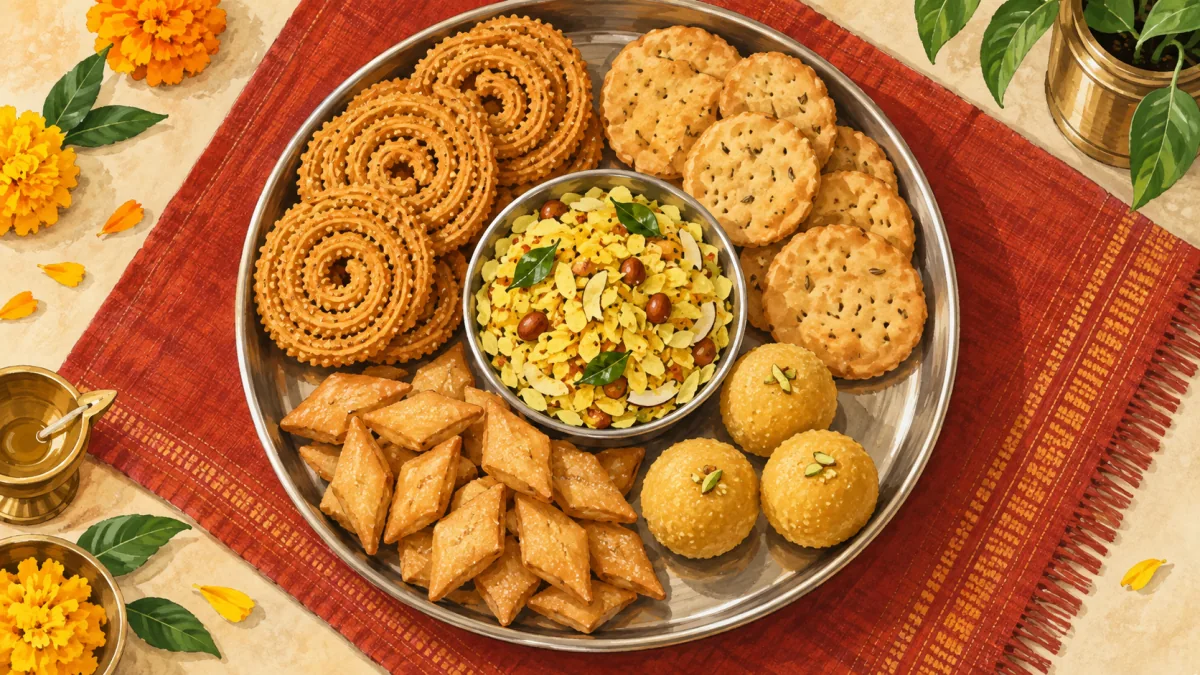
For every box of sweets that changes hands at Diwali, a tin of something salty and crisp sits on the kitchen counter, opened every time someone walks in. In Maharashtra it is called faral; in Gujarat, nasta; in the north, simply namkeen. Whatever the name, it is the food that actually gets eaten over the five days, because nobody can manage a ladoo at every visit.
This guide covers what a savoury platter looks like in different regions, four recipes that a home kitchen can manage, how to keep everything crisp for two weeks, and what to look for if buying.
The faral tradition
In Maharashtrian homes the days before Diwali are spent making faral: a set of snacks and sweets prepared in bulk and stored in steel tins to last the festival and the visitors. The classic set is chakli (spiral rice-flour crisps), chivda (spiced flattened rice), shankarpali (sweet fried diamonds), karanji (stuffed crescent pastries), besan or rava ladoo, and anarsa. Neighbours exchange plates of faral, and the quality of a family’s chakli is a matter of quiet pride.
Gujarati homes make a similar set: mathiya, chorafali, ghughra, sev, and a range of dry snacks. North Indian homes lean on mathri, namak para, shakkarpara and chivda. In the south, murukku (the chakli cousin), thattai and ribbon pakoda are made for Deepavali, alongside sweet adhirasam.
The common thread: fried, dry, spiced, made in bulk, stored in tins, and shared.
Recipe 1: Chakli (murukku)
The spiral is the signature. You need a chakli press (a small cylinder with a star-shaped disc), which costs under ₹150 in any utensil shop.
Ingredients (for about 30)
- Rice flour, 2 cups
- Roasted gram flour (besan) or urad dal flour, ½ cup
- Butter or hot oil, 2 tablespoons
- Sesame seeds, 1 tablespoon
- Cumin seeds, 1 teaspoon
- Red chilli powder, 1 teaspoon
- Turmeric, ¼ teaspoon
- Asafoetida, a pinch
- Salt, 1 teaspoon
- Water, about ¾ cup
- Oil for deep frying
Method
- Mix the flours, spices, seeds and salt. Rub in the butter or hot oil until the mixture looks like breadcrumbs; this is what makes chakli crisp rather than hard.
- Add water a little at a time to make a soft, smooth dough that is not sticky. Rest 10 minutes.
- Fill the press. On a sheet of baking paper or the back of a greased plate, press out spirals about 6 cm across, starting from the centre and working outward, two or three turns.
- Heat oil to medium (a small piece of dough should rise steadily, not shoot up). Slide four or five chaklis in at a time. Fry, turning once, until golden and the bubbling subsides, about 3 to 4 minutes.
- Drain on paper. Cool completely before storing.
What goes wrong: dough too wet, and the spirals absorb oil and go soft. Dough too dry, and they break in the press. Adjust water a spoon at a time.
Recipe 2: Mathri
North India’s flaky, salted biscuit. Eaten with pickle or tea.
Ingredients (for about 25)
- Refined flour (maida), 2 cups
- Semolina (rava), ¼ cup
- Ghee or oil, ¼ cup
- Carom seeds (ajwain), 1 teaspoon
- Black pepper, crushed, ½ teaspoon
- Salt, 1 teaspoon
- Water, about ½ cup
- Oil for frying
Method
- Mix flour, semolina, ajwain, pepper and salt. Rub in the ghee until crumbly.
- Add water to make a stiff dough. Rest 20 minutes under a cloth.
- Roll into balls the size of a small lime. Flatten each to a 5 cm disc about 4 mm thick. Prick all over with a fork so it does not puff.
- Fry on low-medium heat in batches. Mathri should cook slowly, 6 to 8 minutes, until pale gold and crisp through. High heat gives a brown outside and a raw centre.
- Drain and cool fully.
What goes wrong: frying too hot. Mathri is patient food.
Recipe 3: Poha chivda
The lightest snack on the platter and the one that vanishes first.
Ingredients (for a large tin)
- Thin poha (flattened rice), 4 cups
- Peanuts, ½ cup
- Roasted chana dal, ¼ cup
- Cashews, ¼ cup (optional)
- Raisins, 2 tablespoons
- Dry coconut, sliced thin, ¼ cup
- Curry leaves, 2 sprigs
- Green chillies, 3, slit
- Mustard seeds, 1 teaspoon
- Turmeric, ½ teaspoon
- Sugar, 1 teaspoon
- Salt to taste
- Oil, 3 tablespoons
Method
- Dry roast the poha in a wide pan on low for 5 to 6 minutes, stirring, until crisp. Set aside.
- In 3 tablespoons of oil, fry peanuts until golden; remove. Fry chana dal, cashews and coconut in turn; remove.
- In the remaining oil, add mustard seeds; when they pop, add curry leaves and chillies, then turmeric.
- Turn off the heat. Add the poha, all the fried items, raisins, sugar and salt. Toss well.
- Cool completely before storing.
What goes wrong: damp poha. Roast until a flake snaps rather than bends.
Recipe 4: Shakkarpara and namak para
The same dough, sweet or salt.
Ingredients (for a large tin)
- Refined flour, 2 cups
- Semolina, 2 tablespoons
- Ghee, 3 tablespoons
- For shakkarpara: sugar, ½ cup, dissolved in ½ cup warm water or milk
- For namak para: salt, 1 teaspoon, ajwain, ½ teaspoon, and ½ cup water
- Oil for frying
Method
- Rub the ghee into the flour and semolina. Add the sweet or salt liquid to make a firm dough. Rest 15 minutes.
- Roll to 5 mm thick. Cut into diamonds or strips with a knife.
- Fry on low-medium until golden, 5 to 6 minutes, in batches.
- Drain and cool.
Variation: for a crunchier sugar-coated shakkarpara, fry plain and then toss in a thick sugar syrup (1 cup sugar, ¼ cup water, boiled to two-thread stage) and spread to dry.
Keeping everything crisp
Fried snacks go soft from moisture and stale from oil oxidising. Both are manageable.
- Cool completely before anything goes into a tin. Warm snacks steam themselves soft.
- Steel tins with tight lids, not plastic containers. Fill them full; air is the enemy.
- A folded paper towel in the bottom of the tin absorbs stray oil.
- Keep away from the stove and from sunlight.
- Do not mix types in a tin. Chivda takes on the ajwain of the mathri.
- Refresh anything that has softened in a dry pan or an oven at 150 degrees for 5 minutes. Cool again before storing.
Properly stored, chakli, mathri and chivda keep for two to three weeks.
Buying instead of making
Most households now buy at least some of the platter, and there is no shame in it. What to look for:
- Fried in what. Groundnut or sunflower oil, or ghee, stated on the label or at the counter. Avoid anything vague.
- Packing date. Fresh namkeen should be under two weeks old when you buy it.
- Sealed packets or tins, not loose from an open bin, for anything you will keep more than a few days.
- Local makers over national brands for chakli and mathri; the small shop that fries every morning is usually better. For chivda and sev, brands are consistent.
- Not too many varieties. Three good ones beat eight ordinary ones.
Putting the platter together
A balanced Diwali savoury platter for a visiting family:
- One spiral or crunchy item: chakli or murukku.
- One flaky item: mathri or shankarpali.
- One light, mixed item: chivda.
- One sweet-savoury: shakkarpara.
- Something from a packet: sev or a good bhujia.
- Alongside: a bowl of dry fruits and a plate of one sweet.
Serve on a steel thali with small bowls, not from tins. Refill between visitors.
Serving with tea
Faral is tea food. Masala chai in the north and west; filter coffee in the south. Salty snacks go with sweet tea, which is why the two arrived together.
The sweet side of the platter is covered in five easy Diwali sweets and, for the ones you would buy, classic Diwali sweets and their origins. For choosing the dry fruits to put alongside, see the dry fruit gifting guide.