
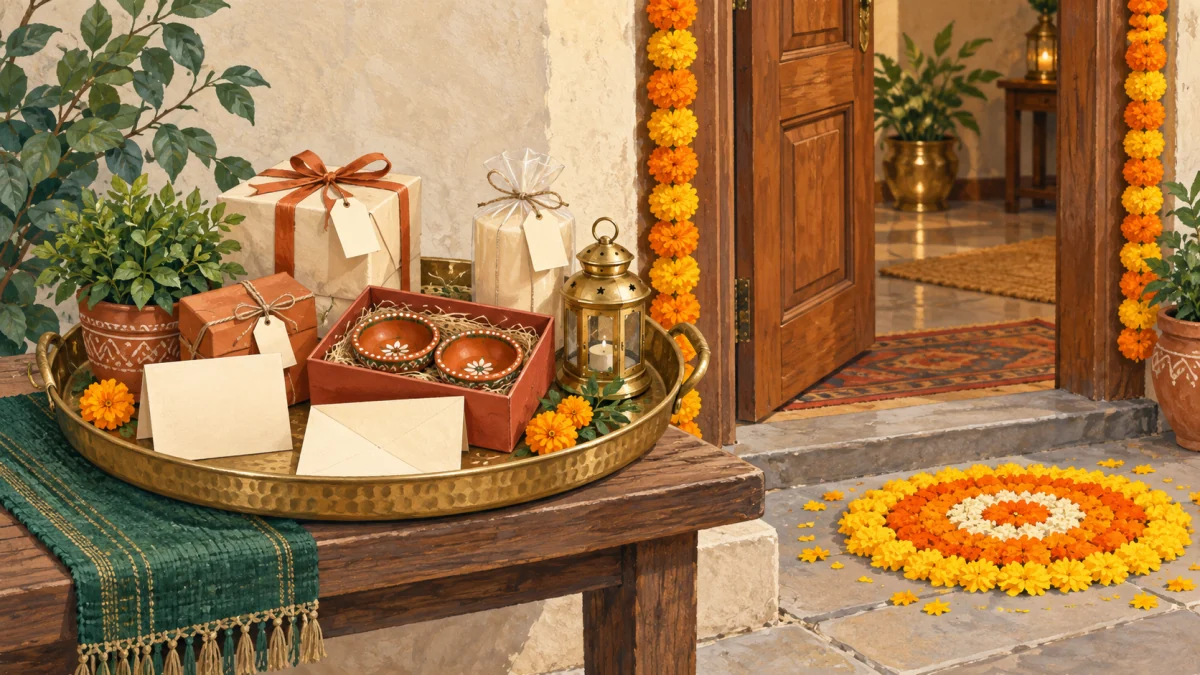
A lot of Diwali happens at the front door. The neighbour who takes in your Amazon parcels, the woman who has cooked in your kitchen for eight years, the watchman who knows your car by its sound, the delivery rider who is at the gate every other day. A gift for them is not charity and it is not payment. It is simply the festival doing what it is meant to do.
The rules are unwritten, and they shift from city to city and community to community. That is exactly why it helps to set them out.
Neighbours
Gifts between neighbours go both ways and are mostly social. The message is “we are glad you live next door”, and nothing more.
What is customary: a box of sweets, a small pack of dry fruits or a set of diyas, taken to the door by hand in the days before Diwali, often by a child of the house. The value is modest; ₹200 to ₹500 is typical.
What works well:
- A set of painted clay diyas. Every home lights them on the night, they are handmade, and a set of twelve is a complete gift on its own. The hand-painted set is the size that suits a doorway.
- A sealed box of one sweet. A 250 g box of kaju katli or ladoo from a shop you trust. Sealed matters, because neighbours end up with a stack of open boxes and no idea how old they are.
- Dry fruits in a small jar. A better choice for older neighbours, or anyone cutting down on sugar.
- Something you made. If you make chakli, murukku or besan ladoo at home, a box of your own is about as personal as a neighbour gift gets. Expect a box of theirs to come back.
Etiquette points:
- Take it to the door yourself, ideally a day or two before the festival.
- Do not send something clearly more expensive than what that neighbour sent you last year. It puts them under pressure.
- Do not pass on a box another neighbour in the same building gave you. Everyone recognises the box.
- If a neighbour does not celebrate Diwali, a sweet box and a greeting are still welcome. Leave out diyas and anything religious unless you know they would like them.
Domestic help
For the cook, the cleaner, the nanny, the person who has been part of the household for years, Diwali is when a year’s work gets acknowledged. In most Indian cities that means a bonus in cash, a gift, and sweets for their family.
The bonus. A common custom is one month’s pay as a Diwali bonus. For part-time help, that means one month of whatever you pay them. Some families give less and some give more. Whatever the amount, put it in a clean envelope, hand it over in person with a word of thanks, and keep it separate from the monthly salary so it is clearly extra. Do not make them ask for it.
The gift. Something alongside the cash, chosen for the person and their family:
- New clothes are the traditional gift. Unless you know their size and taste well, give the money for clothes they pick themselves.
- A sealed box of sweets or dry fruits that goes home to their family. A proper box, not something left over from another gift.
- Practical things for the kitchen: a steel dabba set, a good thali, or a pressure cooker if they have been with you a long time.
- Diyas, a toran and a puja kit for their own home. They are celebrating too. A ready-made basket such as our Family Celebration Hamper, with brass diyas, floating candles, a toran and a card, covers this in one go.
Etiquette points:
- Give it a day or two before Diwali, so they can use it for their own festival and not on the day they are busy working for yours.
- Give them the festival off. If you are hosting and genuinely need them that day, pay double and tell them in advance.
- A gift alone is not a bonus. Cash is expected, and it is needed.
- Do not hand over leftovers, opened boxes or things you were given and did not want. It is always noticed.
Drivers, security staff and building workers
For the driver, the watchman, the building’s cleaning staff and the lift operator, the custom is a smaller cash gift and sweets.
- A full-time driver: treat the same as domestic help. A month’s bonus, a gift, sweets.
- Watchman and building staff: many housing societies collect a Diwali fund from residents and share it out among the staff. If yours does, contribute. You can still give a personal envelope and a sweet box to the people you see every day. ₹200 to ₹500 each, with sweets, is usual for individual gifts.
- Gardener, car cleaner, other part-time workers: ₹200 to ₹500 and sweets, given to them directly.
Give it in an envelope, with a greeting. One small sealed box each is better than a big tray of assorted sweets passed round ten people.
Delivery riders, the postman, the milkman, the newspaper vendor
These are the people who come to the door daily but do not work for you. A sweet box or a little cash before Diwali is an old custom in Indian neighbourhoods, and over the last few years it has quietly stretched to cover delivery riders too.
- Keep a few small sealed sweet boxes or dry fruit pouches near the door in Diwali week, and hand one to whoever rings the bell.
- ₹50 to ₹200 in an envelope is common for the postman, the doodhwala and the paperwala, depending on how many years they have served the house.
- A glass of water or a cold drink on a warm afternoon in the busy weeks before Diwali is remembered too.
Teachers, tutors, the family doctor
Keep these modest and free of obligation. A box of dry fruits or a good sweet, ₹300 to ₹800, with a card. Never cash. For school teachers, check whether the school has a rule; many discourage anything beyond a token.
What to avoid across the board
- Firecrackers as a gift for staff or their children. Unsafe to hand out, and restricted in many cities.
- Alcohol. Out of place in almost every case.
- Used or opened items. That includes the assorted sweets you were given and could not finish.
- Gifts that assume a religion. Idols, pictures or puja items for someone whose faith you do not know. Diyas and sweets are safe; a Lakshmi image may not be.
- Making people wait, or ask. The bonus and the gift should arrive before anyone has to bring it up.
- Giving in public. The watchman’s envelope does not need an audience.
A short plan
- Two weeks before: make the list. Neighbours by flat number, staff by name, then the daily visitors.
- Ten days before: buy sealed sweet boxes, dry fruit pouches and diya sets in the numbers you need, plus a couple of spares.
- One week before: withdraw cash for the envelopes and write a name on each.
- Three or four days before: give staff their bonus and gifts. Take the neighbour gifts round.
- The last few days: hand sweets to the daily visitors as they come by.
For neighbour and staff gifts in quantity, the smaller items in Diyas & Lights and Home Decor are priced for buying several. For choosing within a fixed amount, see Diwali gifts under ₹500.