
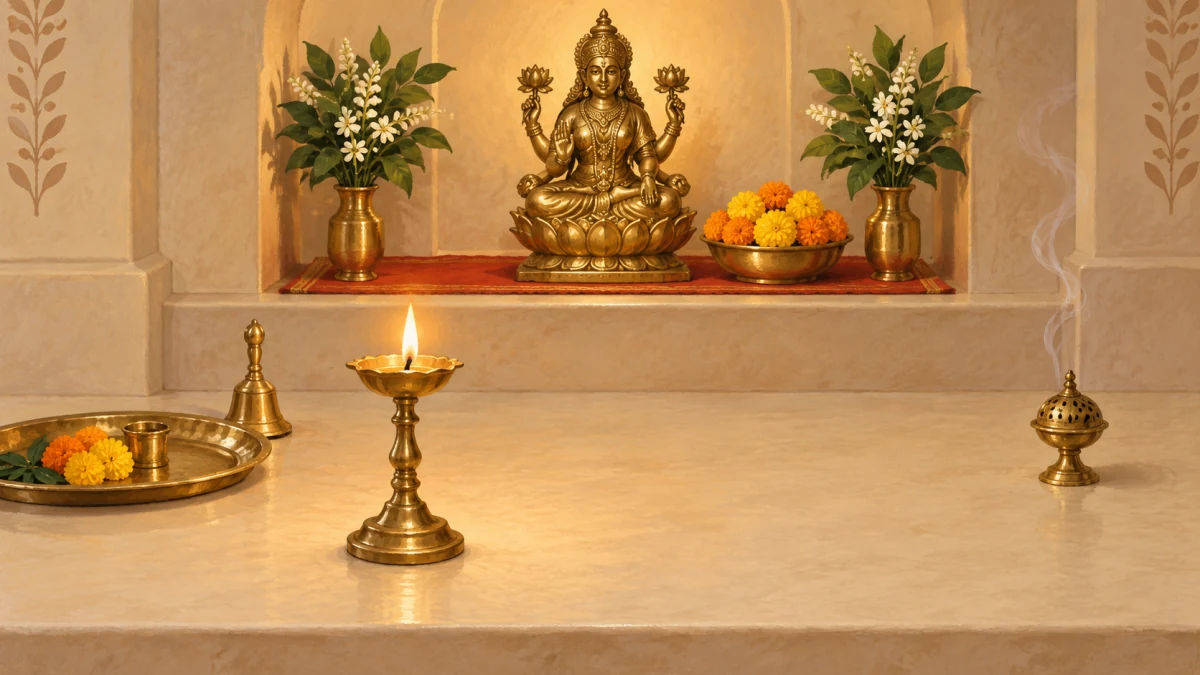
Maybe this is your first Diwali in a new flat in another city. Maybe the person who always led the puja, a grandmother or a father, is not there this year. Either way, if you are the one sitting in front of the altar for the first time, this guide is for you. It walks through the household Lakshmi-Ganesh puja in the order most north Indian families follow, explains what each step is for, and tells you what to do when you do not know the Sanskrit.
Two things before you start. First, there is no single correct way. Regions, communities and families all differ, and whatever your elders taught you outranks this page. Second, sincerity matters more than precision. A puja done with attention and a few mistakes is still a puja done.
Before you begin, the preparation checklist lists everything to have ready. This guide assumes the altar is set, the kalash is placed, the thali is laid and the muhurat is about to start.
The shape of the puja
Almost every Hindu puja has the same shape: purify, resolve, invite the deity, treat them as an honoured guest (seat, wash, dress, feed, light), praise them, ask for blessing, and distribute the food. Lakshmi puja adds Ganesh first, because Ganesh removes obstacles and is worshipped before any undertaking, and adds the kalash, coins and account books, because Lakshmi is wealth.
Hold on to that shape and every step below will make sense, even if you lose your place halfway through.
Step 1: Light the lamp and settle
Sit facing the altar, east or north if possible. Light the main ghee lamp from a matchstick, then light the incense from the lamp. Ring the bell once. Take a breath. The lamp stays lit through the whole puja.
Step 2: Purification (achaman and sprinkling)
Take a spoon of water from the thali in your right palm and sip it three times, saying, if you know it, Om Keshavaya namah, Om Narayanaya namah, Om Madhavaya namah. If you do not, simply sip with attention. Then sprinkle a few drops of water on yourself, on the puja items and on the altar. This is achaman, the symbolic cleansing of the person and the space.
Step 3: Sankalp, the resolve
Hold a little rice, a flower and a coin in your right hand, with a few drops of water. State, in any language, who you are, where you are, the day, and that you are performing Lakshmi puja for the well-being of your household. Place the items before the altar. This is the sankalp: the moment the puja formally begins, and the one step that genuinely should be in words you understand.
Step 4: Ganesh puja
Ganesh sits to the right of Lakshmi (your left). Offer, in turn:
- A drop of water at his feet (padya).
- Kumkum and rice on his forehead (tilak).
- A flower and durva grass.
- A little janeu (sacred thread) placed on him.
- A piece of sweet or a ladoo.
Say Om Gan Ganapataye namah if you know it, or simply ask him to remove obstacles from the puja and the year ahead. Ring the bell. Then move to the kalash.
Step 5: The kalash
The kalash represents the universe, and the water in it the sacred rivers. Touch it, offer kumkum and rice to it, place a flower on the coconut, and ask the deities to be present in it. In many families, Varuna, the deity of water, is invoked here; if you do not know the mantra, a simple invitation in your own words is used.
Step 6: Invoking Lakshmi (avahan)
Now Lakshmi. Sprinkle water on the idol or image. Hold a flower in both hands, look at the image, and invite Lakshmi to be present in it for the puja. Place the flower at her feet. If you know it, Om Shri Mahalakshmyai namah is the simplest mantra; repeat it as you offer each item in the next step.
Step 7: The sixteen offerings (shodashopachara)
Tradition lists sixteen ways to honour a guest. In a household puja most are symbolic and take a few seconds each. Do them in order, with the mantra or a word of offering:
- Aasan – place a flower or a little rice as a seat.
- Padya – water at the feet.
- Arghya – water offered to the hands.
- Achaman – water offered to sip.
- Snan – a few drops of water, or panchamrit if you made it, on the idol (wipe gently afterwards). Clay and paper images: sprinkle only.
- Vastra – a new cloth or a piece of red fabric, or moli, draped or placed.
- Yajnopavita – sacred thread (for Ganesh; Lakshmi is often offered moli instead).
- Chandan – sandalwood paste on the forehead.
- Kumkum and haldi – tilak.
- Akshat – rice grains at the feet.
- Pushpa – flowers and the garland.
- Dhoop – wave the incense before the image.
- Deep – wave the lamp before the image.
- Naivedya – place the sweets and fruit before her, sprinkle water around the plate, and offer with a moment of silence or Om Shri Mahalakshmyai namah, naivedyam samarpayami.
- Tambul – a paan leaf with betel nut, cloves and cardamom.
- Dakshina – coins or a note placed before the idol.
At this point place the account books or ledger, if used, before Lakshmi and mark a swastika and “Shubh Labh” on the first page in kumkum.
Step 8: Prayers and praise
If your family recites the Shri Suktam, the Lakshmi Chalisa or the Ashtalakshmi Stotram, this is where they go. If you do not know them, read the Lakshmi Chalisa from a book or a phone in any script you can read; it takes five minutes. Or sit quietly with the family for two minutes. Both are acceptable in most households.
Step 9: The aarti
Light the camphor in its holder on the thali, or use the thali’s ghee diya. Stand, and holding the thali in both hands, move it in slow clockwise circles before the image: three times at the feet, three at the middle, three at the face, then large circles around the whole. Ring the bell with the other hand or have someone ring it. Sing the aarti; Om Jai Lakshmi Mata is the one most north Indian families use. Everyone present stands and claps or sings.
After the aarti, pass the thali around; each person cups their hands over the flame and touches them to their eyes and head.
Step 10: Pushpanjali and pradakshina
Everyone takes a few flowers and rice, holds them to their forehead, and offers them at Lakshmi’s feet together. Then, if there is room, walk once clockwise around the altar (or turn once in place), which is pradakshina.
Step 11: Prayer and asking
The moment for the family’s own words. Thanks for the year; the ask for the year ahead. Children can say their own.
Step 12: Prasad and lighting the house
Take the naivedya from the altar; it is now prasad. Give a piece to everyone, elders first. Then take a wick from the puja lamp’s flame and light the diyas of the house from it: the altar corners, the doorway, the windows, the balcony. This is the moment the house becomes Diwali.
After the puja
- Leave the main lamp burning as long as it is safe to do so; many families keep it lit all night, in which case it must be on a stone or steel surface with nothing near it.
- Leave the doors open for a while, a custom that welcomes Lakshmi.
- The kalash is kept overnight and the water poured on plants the next morning.
- Coins from the altar are kept in the cash box or the safe through the year.
- Flowers and leaves go to a plant pot or a tree; do not throw them in the drain.
If you do not know any of the mantras
You have three honest options, and all are widely used:
- Do the puja in your own language. Say what you are offering and why, in Hindi, Tamil, Bengali, English or whatever you think in. Words you mean are still prayer.
- Read from a book or a screen. Lakshmi puja vidhi booklets in Hindi, English and regional scripts cost very little and are sold outside most temples and at puja stores. Reading the mantras with attention is fine.
- Play a recording of the aarti and sing along. Plenty of families do this now, and nobody minds.
What matters is that the puja is done with care. Nobody is grading pronunciation.
Common questions
Which way should I face? East or north are preferred. If the room does not allow it, face the altar.
Can the puja be done by a woman alone? Yes. In most households the women of the family lead Lakshmi puja.
Can I do it if I have not fasted? Yes. Fasting on Diwali is a personal choice, not a requirement.
What if I miss the muhurat? Do the puja anyway, that evening. The muhurat is the best time, not the only time.
Do I need a priest? No. Lakshmi puja is a household puja.
What if I break something or the lamp goes out? Relight it, apologise silently, continue. It is not an omen.
Many of the dry items for the puja (roli, chawal, kalawa, camphor, agarbatti, cotton wicks, supari) come together in our complete puja samagri kit, and thali sets are in Puja Essentials. For what goes on the thali and why, read the puja thali guide.