
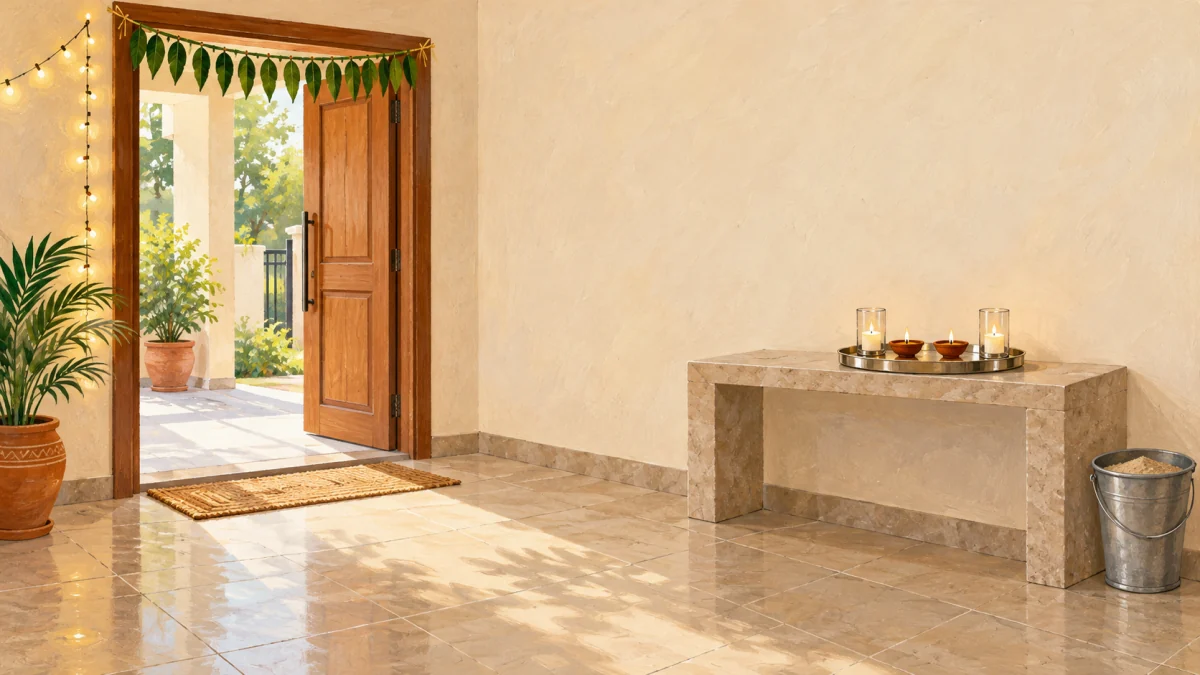
Burns, eye injuries and breathing trouble from smoke are a grimly familiar part of Diwali week in emergency wards from Delhi to Chennai. Most of them start with something small: a dupatta brushing a diya, a child leaning over a sparkler, a string of lights plugged into an overloaded extension board. A few habits prevent most of it, and most of those habits take less than a minute.
It is written for an ordinary household, not a fire brigade, so the advice is short and specific.
Open flames: diyas, candles, incense
A Diwali home can have thirty or more flames burning at once. Treat each one as a small fire, which is what it is.
Placement
- Every diya and candle on a heat-resistant surface: stone, tile, steel plate, glass holder. Never directly on wood, plastic, paper, cloth or a painted surface.
- At least 30 cm from anything that can burn: curtains, torans, garlands, paper decorations, bedding, gas cylinders.
- Below, not beside, hanging things. A toran above a row of diyas is fine at 30 cm or more; a diya on a shelf next to a curtain is not.
- On a stable base. A diya that rocks will spill. Check with a fingertip before lighting.
- Out of the walkway. Not on the floor of a corridor, not on a step people use, not at the edge of a table.
- Away from fans. A ceiling fan on high will tip a flame sideways into whatever is next to it.
Fuel
- Cooking oil or ghee in diyas. Not kerosene, not petrol, not lamp oil.
- Fill to two-thirds. A full diya spills when moved.
- Keep the oil bottle away from the flames while filling.
Supervision
- Never leave a room with a flame burning if no adult is in it. Put out diyas in rooms you leave.
- Put out every outdoor and balcony flame before sleeping, unless it is inside a lantern on a stone surface with nothing near it.
- The puja lamp left burning overnight: on stone or steel, in the centre of a cleared space, with a metal cover or a wide plate under it, and the door of that room open.
Clothes
- Cotton over synthetic during the puja and while lighting diyas. Polyester and nylon melt onto skin.
- Tie back loose dupattas, saris and long hair when bending over a flame.
- Sleeves rolled up while lighting.
Putting out a small fire
- A bucket of water and a bucket of sand near the entrance and the puja room, for the five days.
- Oil fires: smother with sand, a steel plate or a wet cloth. Do not pour water on burning oil; it spreads.
- Cloth fires: water, or smother.
- If a person’s clothing catches fire: stop, drop, roll. Wrap them in a blanket or a thick cloth. Then cool the burn with running water for 20 minutes.
Incense
Incense is a smouldering ember. Keep it in a proper holder over a plate, away from curtains, and burn it in a room with a window open. Charcoal-free agarbatti and dhoop produce less smoke. Do not burn incense in a closed bedroom overnight.
Electrical lights
Buying
- LED, warm white, with an ISI mark or BIS registration on the plug and controller.
- A proper moulded Indian plug, not bare wires twisted into a socket.
- Check the wire along its full length for cracks or exposed copper before hanging, every year.
Installing
- Plug and controller indoors or under cover. Only the wire goes outside.
- Do not chain more than three strings from one plug. Give each its own socket, or use a good extension board with a switch and a fuse.
- One extension board per socket. Do not plug an extension board into another extension board.
- Cable ties or clips to hold the wire. Not nails through it, not tape over the controller.
- Keep wires away from the toran, curtains and, especially, diyas and candles. LEDs run cool but the controller and plug get warm.
- Nothing electrical in direct rain or where water pools. If a string gets wet, unplug it and let it dry fully before using.
Running
- Switch off when leaving the house and before sleeping.
- If a string flickers, smells or the controller is hot to touch, unplug it and retire it.
- Children do not plug in or unplug lights.
The Diwali lighting guide covers what to buy; this is how to use it without incident.
Fireworks
The safest fireworks are none, and our eco-friendly guide makes the case. If your family uses them:
Legal first. Many cities and states restrict fireworks by type, by hour (often 8 pm to 10 pm) and by certification (“green crackers”). Housing societies often ban them entirely. Know the rule where you live; a fine is the mildest consequence.
Buy
- From a licensed shop, in sealed packets with the manufacturer’s name. Not loose from a roadside stall.
- Certified green crackers if your state requires them.
- Nothing that is sold as louder or bigger. The loud ones are the ones that injure.
Set up
- An open area: a terrace with a parapet, a compound, a road that is closed. Not a balcony, not under a tree, not near a parked vehicle or an overhead wire.
- A bucket of water and a bucket of sand within reach.
- Fireworks stored in a closed metal or thick cardboard box, away from the lighting area, brought out one at a time.
- Everyone in cotton clothes, footwear on.
- Spectators at least 5 m back; more for anything that flies.
Light
- One adult lights; everyone else watches. Children under 12 do not light anything, including sparklers, without an adult’s hand on theirs.
- Light with a long incense stick or a lighter with a long neck, at arm’s length, body to one side, never bending over the firework.
- Light and step back immediately. Do not lean in to check.
- If it does not go off, wait five minutes, then drown it in the water bucket. Do not relight, do not pick it up, do not look into it.
- Never hold a lit firework in the hand, except a sparkler, held at arm’s length and away from the face.
- Never put fireworks in a bottle, a tin or a pipe to “aim” them.
Afterwards
- Spent fireworks into the water bucket, then into dry waste the next day.
- Check the terrace and the ground for anything still smouldering before going in.
First aid for burns
- Cool running water for 20 minutes. Not ice, not toothpaste, not ghee, not butter.
- Remove rings, bangles and tight clothing from the area before it swells.
- Cover with a clean, dry cloth. No cotton wool.
- Any burn larger than the person’s palm, any burn on the face, hands, feet or genitals, any burn that is white or charred: go to a hospital.
Eye injuries
- Do not rub. Do not wash with anything but clean water. Cover loosely and go to a hospital immediately. Eye injuries from firecrackers are among the most serious Diwali injuries, and the least forgiving of delay.
Children
- Diyas and candles out of reach of anyone under 8: on high shelves, on tables in the centre, in lanterns. Battery tealights for their rooms and for them to “light”.
- Every flame has an adult in the room.
- Matches and lighters put away, not left on the puja shelf.
- Sparklers are fireworks; the tip burns at over 1,000 degrees. Adult’s hand over the child’s, arm’s length, cotton clothes, a bucket of water for the spent wire.
- Teach stop, drop, roll before the festival, as a game.
- Keep a burn kit: clean cloth, a bottle of water, the number of the nearest hospital on the fridge.
Pets
Diwali is the worst week of the year for most dogs and many cats. Noise, smoke, open flames and strangers at the door.
- A closed, quiet room with their bed, water, a fan for white noise and, if they like it, the television on. Curtains drawn.
- Inside the house during any fireworks hour, always. Dogs bolt at the first bang and are the reason for most “lost pet” posts in the week after Diwali.
- ID tag on the collar with a phone number, for the five days.
- No diyas or candles at floor level in rooms a pet uses. A wagging tail is a fire hazard.
- Keep sweets, especially anything with chocolate, raisins or xylitol, away from dogs.
- Feed a little earlier, walk them before dusk, and do not force them out during fireworks.
- Street animals: a bowl of water outside and, if you can, a sheltered corner. Do not tie fireworks to or near them, and stop anyone who does.
Elderly family members
- Diyas on stable, wide-based lamps at waist height, not on the floor where they have to bend.
- Ready-made wicks so nobody is rolling cotton by a flame with unsteady hands.
- A clear path from bedroom to bathroom with no floor diyas or wires.
- Smoke from fireworks and incense makes breathing harder for anyone with asthma or a heart condition; keep those rooms closed and ventilated separately.
A five-minute checklist for each evening
- Buckets of water and sand at the door and the puja room.
- Every diya on a plate or in a holder, 30 cm from anything that burns.
- Curtains tied back near flames; fans off in rooms with diyas.
- Lights plugged in one string per socket, controllers indoors.
- Pets in their room; children’s flames supervised.
- Before bed: every outdoor flame out, all lights off, the puja lamp checked.
None of this takes the joy out of the festival. It is the difference between a Diwali remembered for the light and one remembered for the hospital. For steadier light, a brass akhand diya with a glass cover keeps its flame out of the draught, and diyas and warm-white string lights are in Diyas & Lights.