
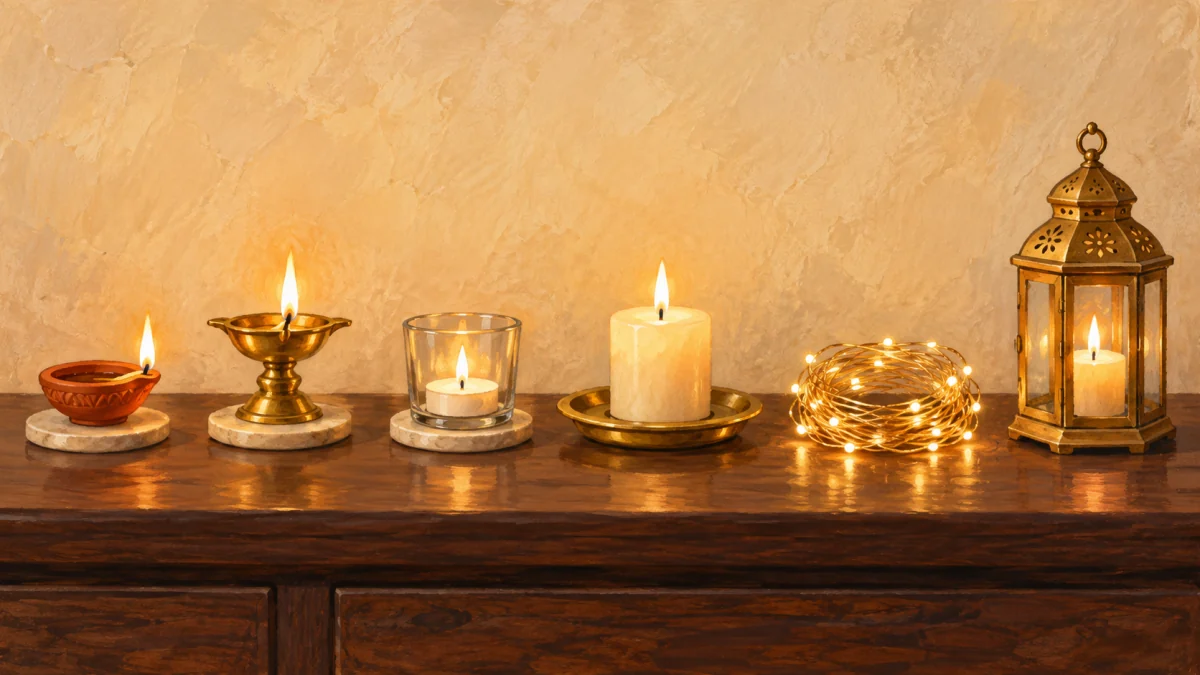
Diwali is Deepavali, a row of lamps. Everything else is decoration; the lights are the festival itself. So it is worth understanding your options properly instead of buying whatever the shop has stacked out front the week before.
This guide compares the six kinds of light Indian homes use at Diwali. For each one: what it is for, how long it lasts, what it costs to run, where it works and where it lets you down. At the end there is a simple plan that puts each one where it belongs.
The short version
| Light | Best for | Burn time | Cost per evening | Weakness |
|---|---|---|---|---|
| Clay diya | Threshold, windows, puja, tradition | 1 to 3 hours per fill | ₹2 to ₹5 in oil and wick | Blows out in wind, spills oil |
| Brass diya | Puja room, the one lamp that stays lit | 2 to 3 hours per fill | ₹3 to ₹6 | Cost of the lamp itself |
| Tealight | Rangoli borders, balconies, tables | About 4 hours | ₹3 to ₹6 | Needs a holder outdoors |
| Pillar candle | Lanterns, dining table | 20 to 40 hours total | ₹5 to ₹10 | Drips, tips, needs a base |
| LED string lights | Railings, windows, walls | Unlimited | Under ₹1 | Wrong colour temperature ruins it |
| Lantern | Wind protection, height, entrances | Depends on candle inside | As per candle | Bulky to store |
Clay diyas
The diya is the whole point. A clay lamp with a cotton wick and a spoonful of oil is what Diwali has meant for as long as anyone has celebrated it, and nothing else quite replaces it.
How they work: the clay absorbs a little oil and the wick draws up the rest. A standard 6 cm diya holds about 15 ml, enough for one to three hours depending on how thick the wick is. Mustard oil, sesame oil and ghee are the traditional fuels, but any cooking oil will burn.
Before first use: soak unpainted diyas in water for a few hours and let them dry, or the dry clay will drink much of the oil before the wick sees any. Painted or sealed diyas can skip this. Our clay diya buyer’s guide explains what to look for at the stall.
Where they work: the threshold, inside window ledges, the puja space, along a rangoli where there is no draught.
Where they let you down: balconies and open verandahs on a windy evening, and anywhere a toddler or a cat can knock them over. Spilt oil stains floors and fabric.
Cost: a set of twelve painted diyas costs ₹200 to ₹300 and lasts several seasons. Oil and wicks for twelve diyas across five evenings come to under ₹200.
Brass diyas
The brass lamp is the one that stays lit through the puja, and in many homes it burns all night on Diwali. It is heavier, holds more oil, absorbs none of it, and lasts a lifetime.
What to choose: solid brass, not “brass finish” plated steel. A heavier lamp is harder to knock over, so pick one up before you buy it. A stand or foot lifts the flame and spreads the light. If the lamp will sit near a ceiling fan or an open window, a glass chimney helps; our brass akhand diya has one for exactly that reason.
Where it works: the puja shelf, the middle of the living-room arrangement, or one on each side of the main door if you have two.
Where it lets you down: nowhere, really, apart from the budget. One good brass lamp can cost as much as three sets of clay diyas. Buy one good one, not five cheap ones.
Care: wipe out the oil after use and clean it with lemon and salt when it dulls. Never use steel wool.
Tealights
A tealight is a small candle in an aluminium cup, and it is the practical stand-in for a diya wherever oil is a nuisance.
Advantages: nothing to spill, soak or position. It burns for about four hours, which is a full evening, and it can sit right on a rangoli without staining it.
Disadvantages: the bare flame goes out in a breeze and the metal cup gets hot. Outdoors, it needs a glass holder.
Where they work: rangoli outlines, dining tables, bathrooms, balcony ledges (in holders), anywhere you want fifty little flames without fifty oil refills.
Cost: roughly ₹6 each in packs of 50, plus a few glass holders for the windy spots.
Pillar candles
Bigger wax candles, 5 to 10 cm across, that burn for many hours. You see them inside lanterns and as table centrepieces.
Advantages: long total burn time, a steady flame inside a lantern, no refilling.
Disadvantages: they drip, they tip over on soft surfaces, and cheap heavily perfumed ones can smell synthetic. Unscented white or cream pillars are the safe buy.
Where they work: inside lanterns, and on a heavy base on the dining table.
Where they let you down: on the floor, on a rangoli, or anywhere windy without a lantern round them.
LED string lights
Fairy lights are the modern Diwali light, and they earn their place, as long as you buy the right colour.
Colour temperature is everything. A diya flame is a deep, warm orange, around 1,800 to 2,000 kelvin. “Warm white” LEDs, at about 2,700 K, are close enough to sit alongside it. “Cool white” (around 6,000 K) and multicolour strings look harsh next to a flame and make a balcony look like a mobile shop. Buy warm white, every time.
Length and count: a 10 m string with 100 LEDs covers a standard balcony railing or a large window. Two strings are enough for a living room and a balcony. Our 10 m warm-white string has 100 LEDs on copper wire and plugs into an ordinary socket.
Power: LED strings draw very little. A few strings running six hours a night through the festival add only a few rupees to the electricity bill. Do not chain more than three strings together; give each set its own socket.
Safety: keep plugs and controllers indoors or under cover. Do not leave strings out in the rain. Check the wire for nicks before you hang it. The Diwali safety guide has the full electrical checklist.
Where they work: railings, window frames, along the edge of a shelf, wound round a pillar.
Where they let you down: draped over the puja altar near a flame, wound through a toran that will hang above diyas, or used as the only light. Fairy lights with no diyas at all look like a wedding lawn, not a home.
Lanterns
A lantern is not really a light source. It is a wind shield with some height. Put a tealight or pillar candle inside, and it burns steadily where a bare flame would not.
Types: a metal frame with glass panels (durable, and protects the flame best); a paper or fabric kandil, traditional in western India and decorative, but meant for a bulb, not a flame; and bamboo or cane with a glass insert.
Where they work: entrances, balcony floors, the dining table, a hook on the verandah.
Cost: roughly ₹600 to ₹1,200 for a metal one that will last years.
Putting them together: a lighting plan
For a typical flat with a balcony, a living room, a puja corner and a front door:
Doorway and threshold: clay diyas, seven along the threshold or steps and one on each side of the door. A lantern on each side if it is windy.
Rangoli: tealights round the outline, or clay diyas if the spot is sheltered.
Puja corner: one brass lamp lit through the puja, and four clay diyas at the corners on the evening.
Living room: three to five diyas or tealights on a tray on the centre table, one string of warm-white lights along the window, and if you like, floating candles in an urli.
Balcony: one string of warm-white lights on the railing, tealights in glass holders on the ledge, a lantern on the floor.
Windows: a clay diya on each inside sill on Diwali night.
That plan uses about 24 clay diyas, one brass lamp, 30 tealights, two strings of lights and one or two lanterns. At the rough prices above, it comes to about ₹2,500 to ₹3,500 in the first year, depending mostly on the lanterns and the brass lamp. After that, you only rebuy wicks, oil and tealights, usually a few hundred rupees a year.
Which to skip entirely
- Cool white and multicolour LEDs. They spoil everything else you have lit.
- Heavily perfumed candles near the puja. Incense is the fragrance of the puja; strong candle perfume competes with it. Keep scented candles for the living room, if you use them at all.
- Battery tealights, except in children’s rooms and places a flame cannot go. They are genuinely useful there, and nowhere else.
- Cheap electric “diyas” with a flickering bulb. A real clay diya costs about ₹20 and looks like what it is.
Browse the range in Diyas & Lights, and for where to put all of this room by room, see Diwali home decor for every room.