
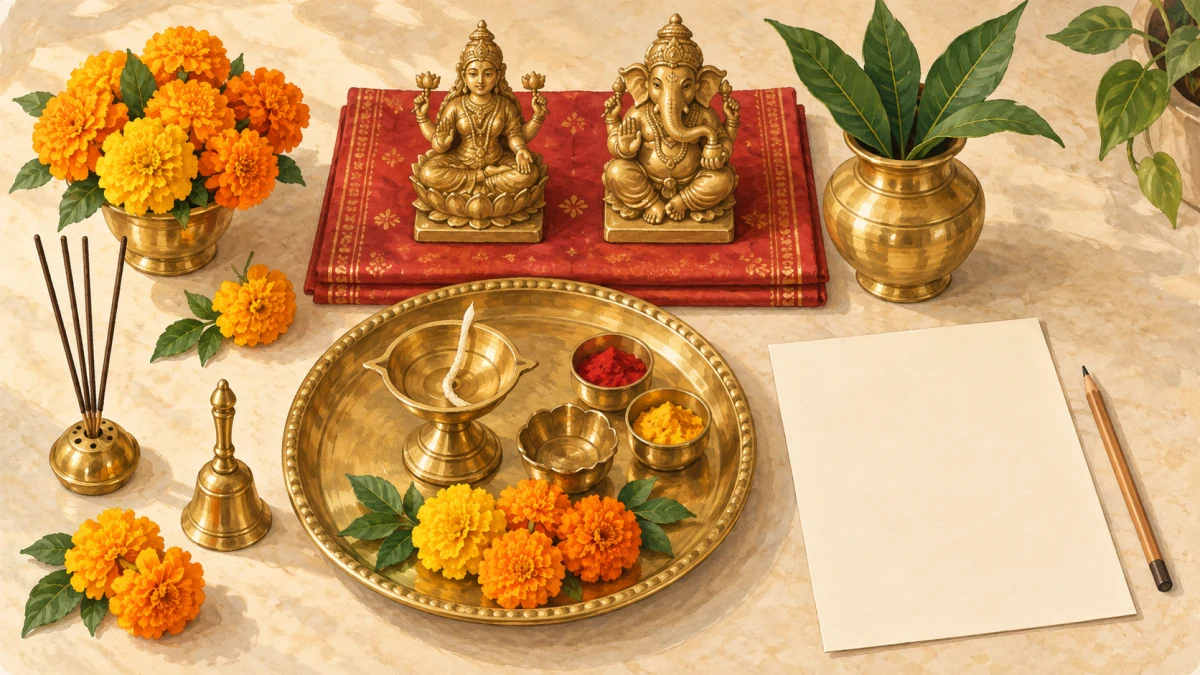
Lakshmi puja comes once a year, on one evening, inside a window of an hour or two. That is exactly the sort of occasion where something is always missing, and you only notice at 6.45 pm, when the kirana store has pulled its shutter down and the flower seller has gone home.
This checklist is meant to be printed and stuck on the fridge. It covers the space, the idols, the dry items, the fresh items, the offerings and the lamps, and finishes with a timeline for the day itself. Every region and every family does things a little differently, so treat this as the common household version and use the blank lines at the end for your own family’s additions.
1. The space
- [ ] Puja room or corner cleaned thoroughly, including behind and under the altar. The cleaning timeline schedules this for the week before.
- [ ] A low table, chowki or shelf for the altar, cleaned.
- [ ] A fresh cloth for the altar: red, yellow or orange. Cotton or silk.
- [ ] A small rangoli or swastika in front of the altar (optional; many families do this).
- [ ] A mat or aasan for the people sitting for the puja.
- [ ] A small plate or bowl for the kalash to stand on.
- [ ] Space cleared for the lamp so nothing flammable is within 30 cm.
2. The idols and images
- [ ] Lakshmi idol or image.
- [ ] Ganesh idol or image (Ganesh is worshipped first, and sits to Lakshmi’s right, i.e. on the left as you face the altar, in most traditions).
- [ ] Kuber or Saraswati image, if your family includes them.
- [ ] Account books, a ledger or, today, a notebook, if your household or business does chopda pujan.
- [ ] Silver or gold coins, or any coins, to be placed before Lakshmi.
- [ ] A small image of the family deity, if separate.
Clay idols bought for the occasion should be unpacked and checked for damage a day before.
3. The kalash
- [ ] A brass, copper or steel pot (kalash or lota).
- [ ] Water to fill it three-quarters, ideally with a little Gangajal added.
- [ ] A coin, a betel nut, a few grains of rice and a flower to drop in.
- [ ] Five mango leaves to arrange around the mouth.
- [ ] A coconut (with husk fibre on top) to sit on the leaves.
- [ ] Moli (red thread) to tie around the neck of the pot.
- [ ] A swastika drawn on the pot in kumkum.
4. Samagri: the dry items
These keep for a year and can be bought well ahead. A boxed kit saves collecting them one by one; our complete puja samagri kit covers many of them, including roli, chawal, kalawa, camphor, agarbatti, cotton wicks and supari. Tick off what the kit has and buy the rest.
- [ ] Roli (red powder) and kumkum
- [ ] Haldi (turmeric powder)
- [ ] Akshat (unbroken rice), about 100 g
- [ ] Chandan (sandalwood) paste or powder
- [ ] Abir and gulal (coloured powders)
- [ ] Moli / kalava (red-yellow thread)
- [ ] Janeu (sacred thread), for Ganesh
- [ ] Camphor (kapur)
- [ ] Cotton wicks, plain and ghee-dipped
- [ ] Ghee for the lamp, at least 100 g
- [ ] Dhoop (cones or sticks) and a holder
- [ ] Agarbatti and a stand
- [ ] Supari (betel nuts), 5 to 11
- [ ] Cloves and cardamom, a few each
- [ ] Mishri (rock sugar)
- [ ] Dry fruits: almonds, cashews, raisins, dates
- [ ] Makhana (fox nuts), for the prasad in some traditions
- [ ] Honey, a small amount
- [ ] Gangajal, a small bottle
- [ ] Matchbox or lighter (the thing everyone forgets)
5. Fresh items: buy on the day or the day before
- [ ] Flowers: marigold, rose, lotus if available. Loose flowers for offering and two garlands for the idols.
- [ ] Mango leaves for the kalash (5) and, if wanted, a toran for the door.
- [ ] Tulsi leaves (not offered to Ganesh in most traditions; used for Lakshmi and Vishnu).
- [ ] Durva grass (a few blades, for Ganesh).
- [ ] Paan (betel) leaves, 5 to 11.
- [ ] Coconut for the kalash and one for breaking or offering.
- [ ] Fruits: banana, apple, pomegranate, any seasonal fruit, five kinds is common.
- [ ] Milk, curd, honey, ghee and sugar for panchamrit, if your family prepares it.
- [ ] Sweets: motichoor ladoo, kheel-batasha (puffed rice and sugar drops), or whatever your family offers. Buy them fresh from your regular sweet shop the day before or on the morning.
- [ ] Kheel (puffed rice) and batasha (sugar drops), traditional in north India.
- [ ] A new cloth or a piece of red fabric to offer.
6. The thali
Set out on a steel or brass thali before the puja:
- [ ] Small bowl of roli/kumkum
- [ ] Small bowl of akshat
- [ ] Small bowl of water with a spoon
- [ ] Flowers
- [ ] Diya (ghee, one or more wicks)
- [ ] Incense stick in holder
- [ ] Camphor in a small holder for the aarti
- [ ] Bell
- [ ] Sweets for offering
- [ ] Moli
- [ ] Coins
A matching set saves hunting for six separate pieces; our Lakshmi puja thali set comes with a diya, kumkum holder, bell, agarbatti stand and kalash. The puja thali guide explains the arrangement.
7. The lamps
- [ ] The main puja lamp: brass, filled with ghee, lit at the start and kept burning through the puja and, in many homes, all night. If the lamp will sit near a fan or an open window, a brass akhand diya with a glass cover keeps the flame steady.
- [ ] Four small diyas for the corners of the altar.
- [ ] Diyas for the doorway, windows and the rest of the house, wicks placed, oil ready (lit after the puja lamp).
- [ ] Enough wicks for five evenings. Two dozen diyas lit each night comes to well over 100 wicks, so buy more than you think.
- [ ] Oil for the outer diyas (mustard, sesame or any cooking oil).
- [ ] A steel plate under every diya.
8. For after the puja
- [ ] Prasad containers to distribute sweets.
- [ ] Sweet boxes for neighbours who visit.
- [ ] A cloth to cover the altar overnight if the lamp is left burning (keep it well clear of the flame).
The muhurat
Lakshmi puja is done in the evening of Amavasya (new moon) during Pradosh Kaal, the period after sunset, with a specific muhurat (auspicious window) that differs by city. In 2026, Diwali falls in the second week of November. Look up the muhurat for your city in a panchang or a reliable calendar a week ahead, write it on the checklist, and plan to be seated fifteen minutes before it begins.
Timeline for Diwali day
Morning
- Bathe, clean the puja space one last time, put the fresh cloth on the altar.
- Buy or receive fresh flowers, fruit, sweets, mango leaves, paan.
- Draw the rangoli at the door and in front of the altar.
- Hang the fresh toran.
Afternoon
- Set the kalash.
- Place the idols, coins, books.
- Lay out the samagri in small bowls.
- Fill the puja lamp with ghee; place wicks in all the outer diyas and fill with oil.
- Prepare panchamrit if used; plate the sweets and fruit.
- Set the thali.
One hour before the muhurat
- Bathe again or wash and change into fresh, traditional clothes.
- Light incense.
- Gather the family; phones on silent.
At the muhurat
- Light the main lamp; begin. The step-by-step guide walks through the sequence.
After the aarti
- Light the diyas at the door, the windows and around the house, starting from the puja lamp’s flame.
- Distribute prasad.
- Open the doors and windows for a while, a custom in many homes.
Blank lines for your family’s additions
- [ ] ____________________
- [ ] ____________________
- [ ] ____________________
- [ ] ____________________
Samagri kits, thali sets, lamps and diyas are in Puja Essentials and Diyas & Lights. Buy the section 4 and section 7 items two weeks out, and leave section 5 for the day itself.