
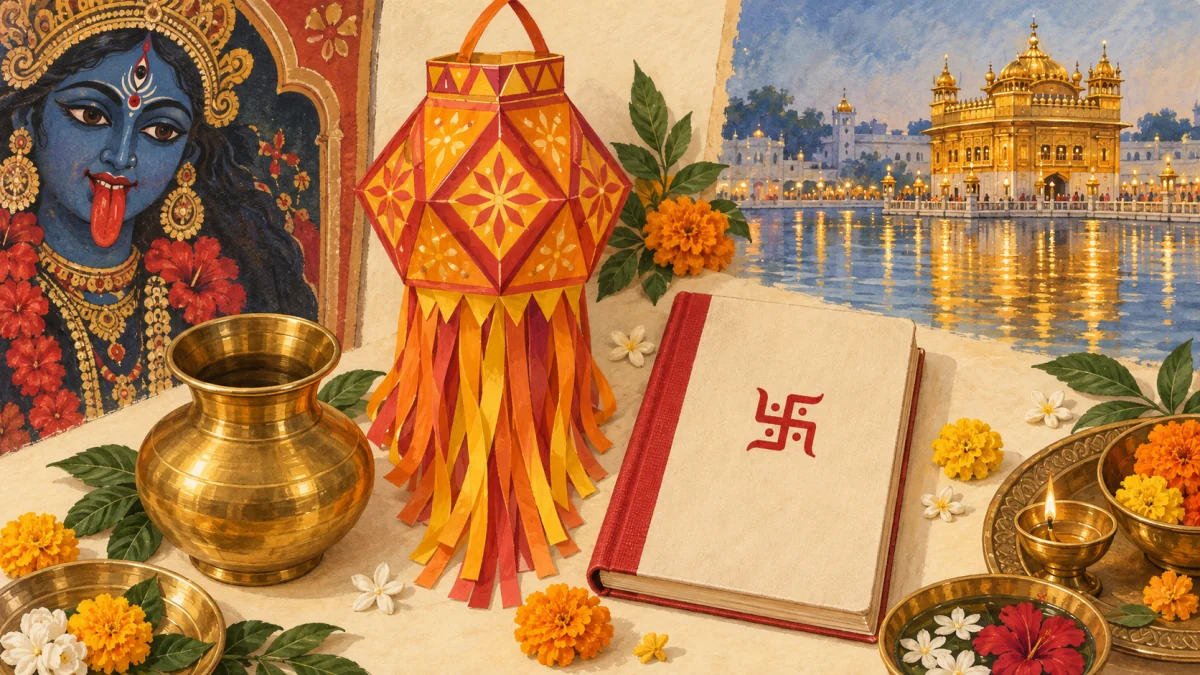
The word Diwali covers a season more than a single festival. The same five days in Kartik are Lakshmi’s night in Delhi, Kali’s night in Kolkata, Krishna’s dawn victory in Chennai, the new year in Ahmedabad, and the day the sixth Guru walked free in Amritsar. The lamps are the constant. Almost everything else changes at the state border.
This guide goes region by region. It is for anyone who has moved from Lucknow to Chennai, or Kolkata to Pune, and found the festival oddly unfamiliar, and for anyone who simply wants to know what the neighbours are up to.
North India: Rama’s return and Lakshmi’s visit
In Uttar Pradesh, Delhi, Haryana, Rajasthan, Madhya Pradesh and Bihar, Diwali is two stories at once. It is the night Rama returned to Ayodhya after fourteen years of exile and the city lit lamps to welcome him; Ayodhya itself now lights hundreds of thousands of diyas on the riverbank on Choti Diwali. And it is the night Lakshmi visits, which is why the Lakshmi-Ganesh puja is the household centrepiece.
The five days run the standard way: Dhanteras purchases, Choti Diwali, the big night, Govardhan Puja with Annakut (largest in Mathura and Vrindavan), and Bhai Dooj. Kheel and batasha are the prasad; clay Lakshmi-Ganesh idols are bought new each year. In Varanasi, Dev Deepawali follows two weeks later on the full moon, when the ghats are lit end to end.
Punjab: Bandi Chhor Divas
For Sikhs, the day coincides with Bandi Chhor Divas, the day of liberation, when Guru Hargobind was released from Gwalior fort by the Mughal emperor Jahangir in 1619 and, by the story, brought fifty-two imprisoned Hindu kings out with him, each holding a tassel of his cloak. He reached Amritsar at Diwali and the Golden Temple was lit in welcome. It still is: the Harmandir Sahib on this night is one of the great sights of India, with lamps along the sarovar and fireworks over the water.
Hindu Punjabis observe Lakshmi puja as in the north, and Bhai Dooj as Tikka. Many families of both faiths visit the gurdwara on the night.
Bengal: Kali Puja
In West Bengal, and in Assam, Odisha and Tripura to varying degrees, the new-moon night belongs to Kali. Pandals with clay images of the goddess go up across Kolkata, the puja is at midnight, and the offerings include red hibiscus, sweets and, in some traditions, meat and fish. The night before, Bhoot Chaturdashi, families light fourteen lamps for fourteen generations of ancestors and eat a dish of fourteen greens.
Lakshmi has her own puja in Bengal, but on the full moon of Ashwin, about two weeks before Diwali, as Kojagori Lakshmi Puja. Alpana designs in rice paste on the floor, and the footprints of Lakshmi, are the Bengali rangoli.
Tamil Nadu and the south: Deepavali at dawn
In Tamil Nadu, and broadly in Karnataka, Andhra Pradesh and Telangana, the main day is Naraka Chaturdashi, the day before the northern Diwali, and the main moment is before sunrise. The family wakes at four or five, the eldest woman applies sesame oil to everyone’s head, and each person bathes with a herbal scrub (abhyanga snan). New clothes are worn, the lamps are lit, elders are greeted, and, where permitted, the fireworks are in the morning, not the night. Breakfast is a full festive spread; Deepavali lehiyam, a digestive paste of jaggery and spices, is eaten first in many Tamil homes.
Lakshmi puja in the evening is observed by many families, especially in Karnataka and the Telugu states, but with less weight than in the north. Kerala has traditionally observed Deepavali lightly, mainly among communities with roots elsewhere, though it is now more widely marked in cities; Onam is the great festival there.
In Karnataka, the day after is Bali Padyami, welcoming King Bali, with rangoli and lamps. Mysore pak, adhirasam and murukku are the foods.
Telangana and Hyderabad
Hyderabad, where this store is based, sits between traditions. Telugu families observe Deepavali with the early oil bath and lamps on Naraka Chaturdashi and Lakshmi puja in the evening of the new moon; north Indian and Marwari families in the city do the full five days; the Old City’s markets, Begum Bazaar and Gowliguda among them, sell diyas, brass and puja items to everyone. Pootharekulu from Atreyapuram and dry fruits are the gift boxes of the city.
Maharashtra: six days and the faral
Maharashtra starts a day early with Vasu Baras, honouring cows and calves, then runs Dhanteras, Naraka Chaturdashi (with the pre-dawn abhyanga snan shared with the south), Lakshmi Puja, Padwa (for husbands and wives, and one of the year’s great muhurats) and Bhau Beej.
Two things are distinctively Marathi. The kandil or akash kandil: the star-shaped or lantern-shaped paper lamp hung from the balcony or the eaves, once made at home, now bought in every size. And the faral: the platter of chakli, chivda, shankarpali, karanji, anarsa and ladoos, made in bulk before the festival and exchanged with neighbours. Diwali pahat, early-morning music concerts on Naraka Chaturdashi, is a Pune and Mumbai tradition.
Gujarat: the year ends and begins
Gujarati Diwali is a year-end. Lakshmi puja on the new-moon night is also Chopda Pujan, the blessing of new account books, and the day after is Bestu Varas, the first day of the Vikram Samvat year. The greeting is Saal Mubarak. Temple visits, elders’ blessings, open houses with sweets and farsan, and the opening of the new ledgers fill the day. Kali Chaudas the night before has its own rituals for dispelling negativity. Rangoli (sathiya) at the door and lamps everywhere; the garba season has just ended, so the festive mood is continuous from Navratri.
Goa: burning Narakasura
Goa’s Diwali is centred on Naraka Chaturdashi and the giant effigies of Narakasura that neighbourhoods build in the days before, sometimes several storeys tall, stuffed with fireworks, and burnt before dawn. The competition between villages for the biggest and most elaborate demon is fierce. After the burning, the oil bath, new clothes, and poha in several forms for breakfast.
Jain Diwali
For Jains, the new-moon night marks the nirvana (liberation) of Mahavira, the last Tirthankara, at Pavapuri in Bihar in 527 BCE. Lamps are lit to symbolise the light of his knowledge. The following day begins the Jain new year. Temples hold special prayers; many Jains fast and read scripture; the mood is devotional rather than festive. Jain communities also do Chopda Pujan and observe Lakshmi puja in a Jain form, as Lakshmi is honoured as a symbol of prosperity through right conduct.
Nepal: Tihar
Across the border, and among Nepali communities in Sikkim, Darjeeling and elsewhere, the same five days are Tihar. Day one honours crows (Kaag Tihar), day two dogs (Kukur Tihar, when dogs are garlanded and fed), day three cows in the morning and Lakshmi at night, day four the ox or the self (Mha Puja for the Newar community, and Nepal Sambat new year), and day five Bhai Tika, the most elaborate of the sibling ceremonies. Girls go from house to house singing bhailo and boys deusi, receiving money and sweets.
Odisha, Assam and the north-east
Odisha combines Kali Puja with Badabadua Daka, calling the ancestors by lighting jute sticks and holding them to the sky. Assam observes Kali Puja and lights akash banti (sky lamps) on bamboo poles. In Manipur, Tripura and among many north-eastern communities, Diwali is observed as a lamp festival with Lakshmi or Kali puja, alongside indigenous festivals of the same season.
What is the same everywhere
Cleaning first. Lamps at the door. A rangoli, by one name or another. Sweets given to neighbours. A god or a guru honoured on the darkest night of the month. The details are regional; the shape is national.
Moving cities
If you have moved and find the festival shifted a day, or the emphasis unfamiliar, the practical answer is to keep your own family’s day and join the neighbours’ too. A Tamil family in Delhi has its oil bath on Chaturdashi morning and lights lamps for the northern Diwali the next evening. A Bengali family in Hyderabad does Kali puja at home and sends sweets to the neighbours for their Lakshmi puja. Nobody minds a second day of lamps.
The five days of Diwali explained gives the north Indian sequence day by day, and the guides to Dhanteras, Govardhan Puja and Bhai Dooj go into the days that vary most by region. For what every region has in common, the lamps, see Diyas & Lights.