
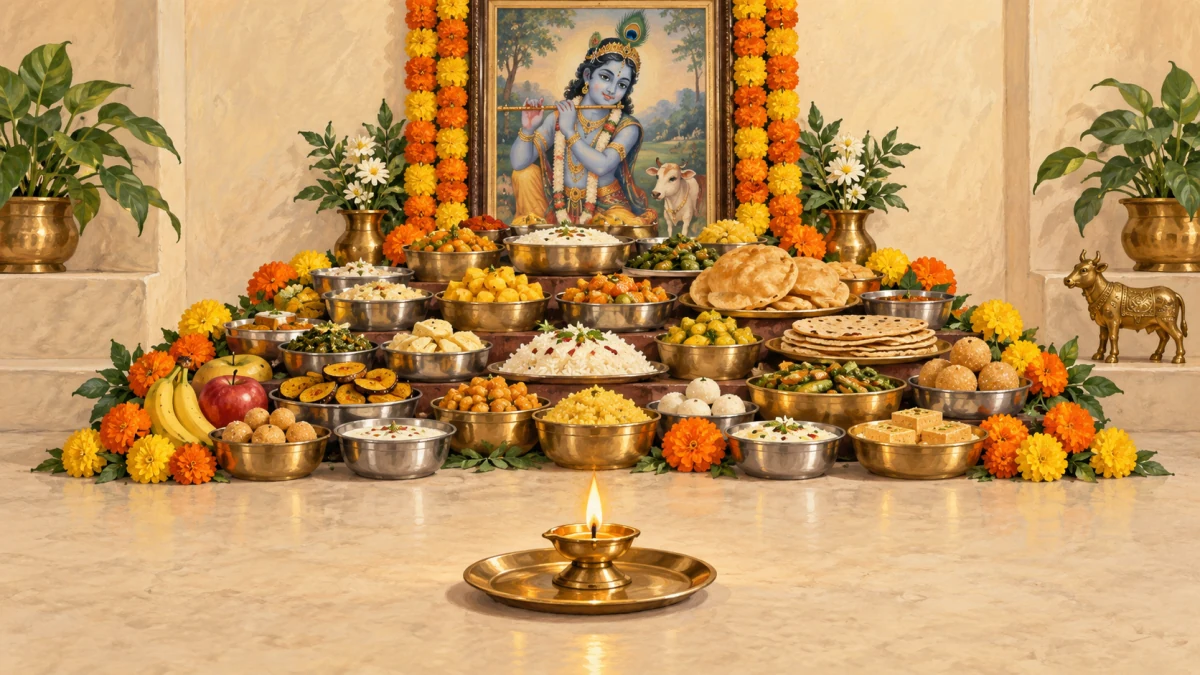
The day after Lakshmi puja is the least understood of the five days of Diwali, because it is three or four different festivals depending on where you are. In Mathura and much of the north it is Govardhan Puja, with a mountain of food. In Gujarat it is New Year’s Day. In Maharashtra it is Padwa, a day for husbands and wives. In the south and in parts of the west it is Bali Pratipada, when a demon king returns to visit his people.
Same date, very different days. This guide takes each in turn, starting with the Krishna story that gives the day its best-known name.
The date
The first day of the bright fortnight of Kartik, Kartik Shukla Pratipada, the day after the new moon of Diwali. In 2026 it falls in the second week of November. Occasionally, because of how tithis fall, there is a day’s gap between Lakshmi puja and this day; a panchang will show it.
Govardhan Puja: the story
The people of Braj, the region around Mathura and Vrindavan, used to hold a grand annual offering to Indra, the god of rain, so that the monsoon would come. The young Krishna asked why. The rain, he argued, came because of the hill, Govardhan, whose forests held the clouds and whose slopes fed the cows; the offering should go to the hill and the cattle, not to a distant god. The villagers agreed and offered the feast to Govardhan.
Indra, insulted, sent a storm to drown Braj. Krishna lifted Govardhan hill on the little finger of his left hand and held it as an umbrella for seven days, and the whole village, with its cows, sheltered beneath it. Indra gave up, and accepted that Krishna was greater. The offering to the hill has been made ever since.
The story is told as a lesson about gratitude to the land and the animals that actually sustain a community, and about a child’s common sense against a priest’s habit.
Govardhan Puja: the ritual
The hill. In homes across the north, a small hill of cow dung is made in the courtyard or at the entrance, shaped and decorated with flowers, grass, small clay figures of cows and Krishna, and sometimes a flag on top. In cities, where dung is scarce, the hill is made of clay, or drawn as a rangoli, or a picture of Govardhan is used. The hill represents Govardhan and, by extension, the earth.
The puja. The hill is worshipped with kumkum, rice, flowers, incense and a lamp, and the family walks around it (parikrama) as pilgrims walk the 21 km around the real hill near Mathura. Cows, where a household has them, are bathed, decorated and fed.
Annakut. The “mountain of food”. A large vegetarian meal is prepared, traditionally of many dishes (56, chhappan bhog, in temples; a dozen or so at home), and arranged in tiers before the Krishna image or the hill, to be offered and then shared as prasad. In temples of the Pushtimarg and ISKCON traditions, the Annakut is enormous, with hundreds of dishes, and the public queues to see it.
The dishes are the usual festival foods: rice, dal, kadhi, vegetables, puri, sweets, and, in Braj, the specific dishes associated with Krishna’s childhood such as makhan-mishri. There are no rules on the menu; the point is abundance offered and then shared.
At home, simplified. Many urban families do a short puja before a Krishna image with whatever has been cooked, mark a small rangoli hill, and share the meal. That is a complete observance.
Gujarati New Year (Bestu Varas)
In Gujarat, the day after Diwali is the first day of the new year in the Vikram Samvat calendar, which the Gujarati community follows. It is called Bestu Varas or Nutan Varsh.
- The day begins with a visit to the temple and to elders for blessings, and greetings of Saal Mubarak or Nutan Varshabhinandan.
- New account books (chopda), blessed at Lakshmi puja the night before, are opened, and the first entry of the year is made. In Gujarati business families this is the real financial new year.
- Homes are open to visitors all day, with sweets and farsan (savouries) laid out. The visiting is the main activity.
- Govardhan Puja is also observed, particularly in Vaishnav households.
Padwa (Maharashtra)
In Maharashtra the day is Diwali Padwa or Bali Pratipada, and it is a day for married couples. The wife performs an aarti for the husband in the morning, with a tilak, and he gives her a gift. It is one of the three and a half most auspicious days (muhurats) of the Marathi calendar, and new ventures, purchases and account books are started on it.
Bali Pratipada (Maharashtra, Karnataka, Goa, Tamil Nadu)
The day also marks the return of King Bali, the generous demon king whom Vishnu, as the dwarf Vamana, pushed down to the netherworld but allowed to return once a year to see his people. In Karnataka and coastal Maharashtra and Goa, Bali is welcomed with rangoli, lamps and a small puja. In Kerala the same king is welcomed at Onam, a different festival, which shows how the same story is placed differently across the country.
Elsewhere
- In Rajasthan and Uttar Pradesh, Govardhan Puja is the main observance, with Annakut in temples.
- In Punjab, the day is Vishwakarma Puja for many artisan communities, honouring the divine architect; tools and machines are cleaned and worshipped.
- In Bengal, the day has no major observance; Kali Puja was the night before.
- In Nepal, it is the fourth day of Tihar, Govardhan Puja or Mha Puja (a Newar ritual of self-purification), and also Nepal Sambat new year.
The Diwali across India article sets these regional patterns side by side.
Observing the day at home
Whichever tradition you follow, the day has three usable elements:
- Gratitude for what feeds you. The Govardhan story is about the land and the cattle. A family meal cooked with care, offered before eating, does the same work as an Annakut.
- A new start. New year in Gujarat, new account books everywhere, the first day of the bright fortnight. It is a natural day to begin something.
- Visiting. Elders, neighbours, the family you did not see on Diwali night.
A puja for the day needs only what is already on the altar from Lakshmi puja: the lamp, incense, kumkum and rice from the puja samagri kit, and the thali. If you draw the Govardhan hill as a rangoli, the reusable rangoli mat set gives a base, with cow and flag shapes added in coloured powder.
The day in the sequence
Govardhan Puja is day four. Dhanteras (day one), Naraka Chaturdashi (day two) and Lakshmi Puja (day three) come before; Bhai Dooj (day five) follows. The five days of Diwali explained lays out the whole run, and the guides to Dhanteras and Bhai Dooj cover the first and last days.