
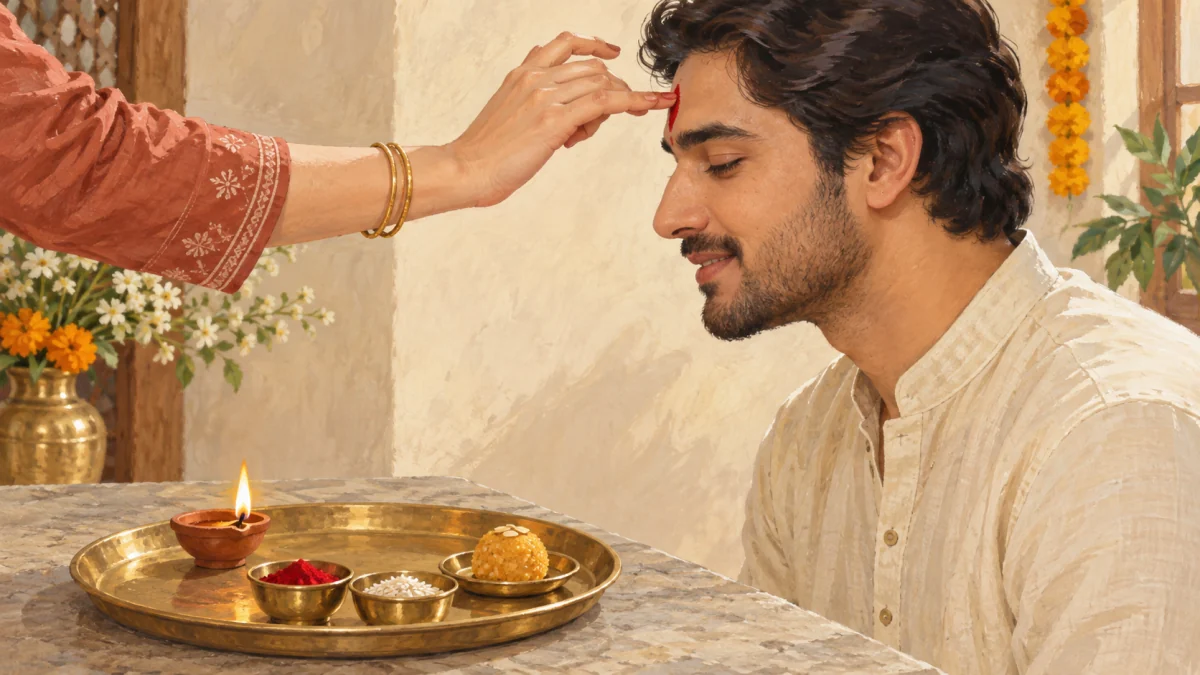
Two days after Lakshmi puja, when the lamps are still up and the sweets are half finished, Diwali ends with the quietest of its five days. Bhai Dooj is a ceremony between sisters and brothers: a tilak, an aarti, a meal, a gift. It has none of the noise of Diwali night and all of its warmth. For many people it is the day they remember best from childhood: a sister’s thumb pressing kumkum onto a forehead, and an envelope passed across a plate of food.
This guide covers the stories behind the day, the ritual as it is done in the north and its variations elsewhere, what is customarily exchanged, and how families keep the day when a brother or sister lives in another city or country.
The name and the date
Bhai Dooj is bhai (brother) and dooj (the second day). It falls on the second day of the bright fortnight of Kartik, two days after the new moon of Diwali. It is the fifth and final day of the festival. In 2026 that is in the second week of November; a panchang gives the tithi for your city.
The same day has other names: Bhau Beej in Maharashtra and Goa, Bhai Tika in Nepal and among Nepali communities, Bhai Phonta in Bengal, Bhathru Dwithiya or Bhagini Hastha Bhojanam in the south, and Yama Dwitiya everywhere, after its main story.
Two stories
Yama and Yamuna. Yama, the god of death, had a twin sister, Yamuna, the river. She invited him again and again to visit; he was always busy. At last he came on this day. Yamuna welcomed him with a tilak, an aarti and a meal she had cooked, and Yama, moved, granted that any brother who receives a tilak from his sister on this day would be protected from untimely death, and any sister who performs it would not be widowed. This is why the day is Yama Dwitiya, and why the sister’s tilak is the central act.
Krishna and Subhadra. After killing the demon Narakasura (the story of Naraka Chaturdashi, the second day of Diwali), Krishna visited his sister Subhadra. She welcomed him with sweets, flowers and a tilak on his forehead. In the west of India this is the story more often told.
Both stories say the same thing: the brother comes to the sister’s home, she honours him, and he is protected by it.
The ritual, as done in north India
Preparation. The sister prepares a thali with a diya, kumkum or roli, rice grains, a few flowers, a sweet, and often a coconut, a betel leaf and a small dish of kheel (puffed rice). A rangoli or a square of flour paste is drawn on the floor where the brother will sit, in some homes.
The ceremony.
- The brother sits facing east or north, on a wooden seat or a mat. In some families he sits on a rangoli-marked square.
- The sister lights the diya on the thali.
- She applies the tilak: a mark of kumkum or roli on the brother’s forehead, with a few grains of rice pressed onto it. In many families it is a vertical line rather than a dot, or a mark of sandalwood paste with kumkum.
- She performs the aarti, circling the thali before him three times.
- She ties a moli (red thread) on his wrist, in some traditions, or places a flower.
- She offers him the sweet, and he eats it.
- She prays for his long life; he touches her feet if she is older, or blesses her if he is, and gives her a gift.
- The sister feeds the brother a meal she has cooked, or at least a dish, and they eat together.
The whole ceremony takes ten minutes. The meal is the long part.
If the sister is older, the brother touches her feet after the tilak. If the brother is older, he blesses her. If there are several brothers and sisters, each sister does the tilak for each brother in turn, usually eldest first.
Regional variations
Bhau Beej (Maharashtra, Goa). The brother sits on a square drawn on the floor; the sister does the aarti and tilak, and the meal typically includes basundi or shrikhand puri. Brothers give gifts, often clothes or cash; a sister without a brother may perform the ceremony for the moon.
Bhai Phonta (Bengal). The sister applies the phonta (a mark of sandalwood paste, kajal and curd, or of ghee and kumkum) to the brother’s forehead while reciting a rhyme that says, in effect, “I put a mark on my brother’s forehead; a thorn at Yama’s door; let my brother be immortal.” She fasts until the ceremony. The meal is elaborate and the brother brings gifts.
Bhai Tika (Nepal and Nepali communities). The most elaborate form. The sister applies a seven-colour tika (saptarangi), walks around the brother pouring a line of oil or water, and offers a garland of makhamali (globe amaranth) flowers, which do not wilt, for a long life. Brothers give money and gifts; sisters receive a tika from brothers in turn.
South India. In parts of Andhra Pradesh, Telangana and Karnataka the day is Bhagini Hastha Bhojanam, “a meal from the sister’s hand”: the brother eats at his sister’s home. The tilak is done with kumkum and turmeric.
Among Sikhs and in Punjab, the day is Tikka; the ceremony is similar to the north Indian one.
What is exchanged
From the sister: the tilak, the aarti, the sweet, the meal, and often a gift she has made or chosen. In many families the sister’s gift is small; her offering is the ceremony itself.
From the brother: a gift or money, given after the tilak. Traditionally clothes (a sari, a dress), jewellery, or cash in an envelope. Today anything the sister would like.
Gift ideas for a sister:
- Something for her home at the end of Diwali, when the rest of the decor is coming down: a brass lamp she will use through the year. The brass akhand diya is the kind of piece that stays on a shelf.
- A puja thali set if she has recently set up a home.
- A set of floating candles for the urli she keeps on the table.
- Clothes, jewellery, a book, cash. The traditional list is traditional because it works.
Gift ideas for a brother, if the family exchanges both ways:
- A beaded door toran for his flat, especially if he is the sort who never gets round to buying decor for himself.
- A pair of brass diyas.
- A box of the sweet he likes, bought locally on the day.
- A shirt, a wallet, a book.
Gifts in this ceremony are modest. It is not a competition and it should not become one.
When siblings are apart
More brothers and sisters live in different cities than ever, and the ceremony has adapted.
- The sister sends a tilak. A small packet of kumkum and rice, a moli and a sweet, posted a week ahead. On the day, the brother applies the tilak himself or has his wife or a child do it while the sister watches on a video call and says the prayer. This is now common and entirely accepted.
- The brother sends the gift by courier to arrive before the day. A gift that arrives late is still a gift; the tilak on the day is what matters.
- A meal on a call. Both cook or order the same dish and eat together on video. Awkward the first year, a tradition by the third.
- The moon. If a sister has no brother, or he cannot be reached, the older custom is to perform the aarti for the moon, or for a plant, or for an image of Krishna. It is not a lesser ceremony.
After the ceremony
Bhai Dooj is the last day of Diwali. In many homes the lamps are lit one final time in the evening and the decorations come down the next day. The five days of Diwali explained sets out how the days fit together, and the guides to Dhanteras and Govardhan Puja cover the days before.
Thalis and lamps for the ceremony are in Puja Essentials.