
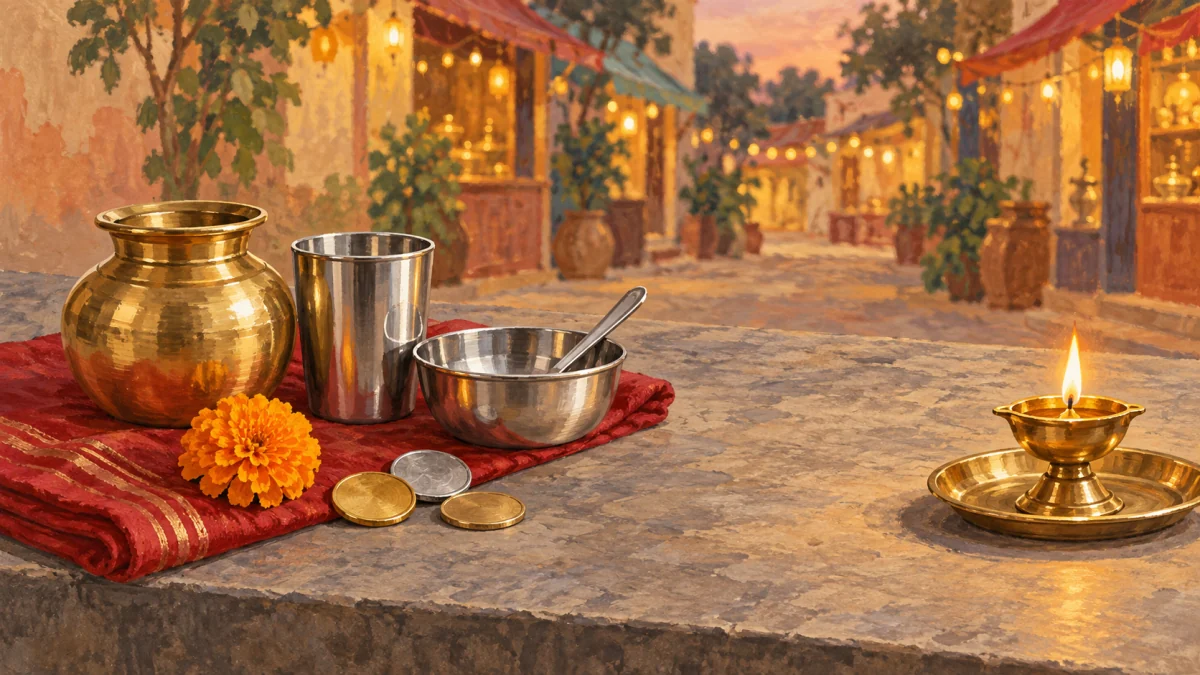
Dhanteras is the first of the five days of Diwali and the one most associated with buying. Markets stay open late, jewellers advertise for weeks beforehand, and even families who buy nothing else that month will bring home a steel spoon or a new broom. Walk through Chandni Chowk, Laad Bazaar or T. Nagar that evening and you will see why. Behind the shopping is a set of stories and a small evening ritual that most people know only in part.
This guide covers the name and the stories, why metal in particular, what is traditionally bought, the evening puja, the lamp for Yama, and how to mark the day on a small budget without feeling you have missed it.
The name and the day
Dhanteras is a contraction of Dhan (wealth) and Trayodashi (the thirteenth lunar day). It falls on the thirteenth day of the dark fortnight of Kartik, two days before the new-moon night of Diwali. In 2026 it comes in the second week of November; the exact date depends on the tithi in your city, and a panchang will give it.
The day is also called Dhantrayodashi and, in its medical aspect, Dhanvantari Jayanti. Since 2016 the Government of India has marked it as National Ayurveda Day.
Two stories
Dhanvantari. In the churning of the ocean (samudra manthan), the gods and demons churned the cosmic sea for the nectar of immortality. Among the things that emerged was Dhanvantari, the physician of the gods, holding the pot of amrit. He appeared on this day, which is why Dhanteras is linked to health as well as wealth, and why Ayurvedic practitioners honour it.
Lakshmi and Kuber. Lakshmi, the goddess of wealth, is also said to have emerged from the churning, and Dhanteras begins the days of welcoming her. Kuber, the treasurer of the gods, is worshipped alongside her on this evening in many homes, particularly in business families.
The prince and the snake. A third, folk story explains the lamp for Yama. A young prince was fated to die of a snakebite on the fourth day of his marriage. His wife kept him awake all night with stories and songs, and piled gold, silver and coins at the door with lamps burning all around. When Yama, the god of death, came as a snake, the glitter and the light dazzled him; he sat listening to the songs until dawn and left without taking the prince. Since then a lamp is lit for Yama on Dhanteras evening.
Why buy metal
The buying custom comes from the association with Lakshmi and with the pot of nectar. Bringing a new metal object, especially gold or silver, into the house on this day is held to invite prosperity for the year. Metal is durable and holds value; a new pot or coin is a small act of confidence about the year ahead.
Over time this became a general belief that anything bought on Dhanteras multiplies, which is why families buy everything from a car to a broom on this day.
What is traditionally bought
Gold and silver. Coins, small ornaments, a silver Lakshmi-Ganesh coin for the puja. This is the classic purchase, and the reason Dhanteras is one of the busiest days of the year at the jeweller’s. If buying, buy hallmarked pieces from a jeweller who gives a proper invoice and purity certificate.
Utensils. For most families the practical purchase: a steel or brass vessel, a set of glasses, a new kadhai, a thali. Copper and brass are traditional; steel is the everyday version. A puja thali bought on Dhanteras is used two days later for Lakshmi puja, which makes the Lakshmi puja thali set the sort of thing people bring home on this day.
A new broom. A widespread custom in the north and west: a broom (jhadu) is bought on Dhanteras, because it sweeps away poverty, and Lakshmi is said to reside in a clean house. It is often the cheapest and most faithfully kept part of the tradition.
Diyas and lamps. The lamps for the five days are bought or set out from Dhanteras. A brass lamp for the puja room is a common Dhanteras purchase in its own right, as a metal object with lasting use. The brass akhand diya is designed for the lamp that stays lit through Diwali night.
Coins for the puja. A few coins, silver if possible, placed before Lakshmi during the puja and kept in the cash box for the year.
Account books. Business families buy new ledgers (bahi khata) to be blessed at Lakshmi puja and opened on the new year.
Larger purchases. Vehicles, appliances, property registrations and electronics are all timed to Dhanteras by many families. Whether this is auspicious or simply a sales season is a matter of belief; the day is auspicious by the panchang, and the discounts are real either way.
What is traditionally avoided
Customs vary, but commonly:
- Nothing made of iron, in some communities (steel is often exempted, since it is what the kitchen uses).
- Nothing black.
- No glass or plastic items as the “Dhanteras purchase” itself.
- No lending money on the day.
- No sharp objects as gifts.
None of these are universal. Your family’s practice is the rule.
The evening puja
Dhanteras evening has a short puja of Lakshmi and Kuber, and often Dhanvantari, done at or after sunset, in the Pradosh period.
- The new metal item is washed and placed before the deities, with a tilak of kumkum and a few grains of rice.
- Lakshmi and Kuber images (or a Kuber yantra in business families) are placed on a red cloth with coins in front.
- A lamp is lit; incense; a simple offering of sweets or fruit.
- A short prayer for health and prosperity; the Lakshmi Chalisa or a few mantras if known.
Many households keep this to five minutes and save the full puja for Diwali night. The step-by-step Lakshmi puja guide covers the full version.
The Yama deepam
The distinctive Dhanteras ritual. After sunset, a single diya, traditionally made of flour dough or clay, filled with mustard oil, is lit and placed facing south outside the main door or near the threshold, sometimes on a heap of grain. It is an offering to Yama for the protection of the family from untimely death, and it is left to burn through the evening.
The lamp faces south because south is Yama’s direction. It is the one time in the year a lamp is deliberately turned that way.
Marking the day on a small budget
The heart of Dhanteras is the new metal item, the lamp and the intention. None of these need to cost much.
- Buy one steel item you actually need. A glass, a spoon, a small vessel. Wash it, put it before the deities, use it on Diwali.
- Buy the broom.
- Light the Yama diya. A clay diya, a spoon of mustard oil, a cotton wick.
- Clean the house. Dhanteras is traditionally the day the cleaning is finished and the decorating begins; the cleaning timeline ends here.
- Set out the lamps for the coming days, so the house is ready.
The gold can wait for a year when it is affordable; the day is not diminished without it.
Dhanteras and health
Because of Dhanvantari, the day has a health dimension that is easy to overlook among the advertisements. Some families use it to start a small health habit for the year, to donate to a hospital or a medicine fund, or simply to have a family meal cooked at home. This is entirely optional and not a rule; it is a way of honouring the older meaning of the day.
Where Dhanteras sits in the five days
Dhanteras is day one. Day two is Naraka Chaturdashi (Choti Diwali), day three Lakshmi Puja (Diwali proper), day four Govardhan Puja, day five Bhai Dooj. The five days of Diwali explained lays out the whole sequence, and the guides to Govardhan Puja and Bhai Dooj cover the days after.
Lamps, thalis and the puja kit for the days ahead are in Puja Essentials and Diyas & Lights.