

Five minutes spent on how to choose kurti size online will do more for a festive order than an hour of scrolling. When the only thing you can pick is a letter, S through to XXL, you are being asked to translate your body into someone else’s cutting pattern with no numbers in front of you. The good news is that you already own half of what you need: a garment that fits you. The other half is the seller’s measurements.
This guide shows you how to measure that garment, what to ask the shop when the page gives no numbers, and what the photograph can tell you that the size name cannot.
How to choose kurti size online when the letter is all you get
S, M, L, XL and XXL are not standardised across Indian clothing. Two garments cut from the same bolt of cloth by two workshops can label the same chest measurement differently, and ethnic wear is cut with ease built in, which varies by style. A straight kurti and a flared anarkali of the same labelled size will feel like different sizes on the same person.
So treat the letter as a starting point and the garment shape as the real information. Check the product description for any detail the seller has given about fit and cut, and use the photographs for the rest. The clothing pages checked for this guide offer a Size dropdown of S, M, L, XL and XXL and give no measurements in inches or centimetres, so there is no chart to match your numbers against.
Measure a garment you already wear
This is more reliable than measuring your body, because it compares like with like. Take something you own that fits the way you want the new piece to fit. Lay it flat on a bed or a table, smooth out the creases, and do the buttons up if it has them.
Chest
Measure straight across from one underarm seam to the other, flat, without stretching. Double that number. That is the garment chest. A kurti that measures 19 inches flat is a 38 inch garment.
Shoulder
Measure from the point where one shoulder seam meets the sleeve, straight across the back, to the same point on the other side. Shoulder is the measurement that is hardest to alter later, so if a piece is right everywhere else and wrong here, it is the wrong piece.
Length
Measure from the highest point of the shoulder straight down to the hem. Length changes how a kurti reads more than almost anything else, and it is the easiest thing to have shortened by a tailor.
Sleeve
Measure from the shoulder seam to the sleeve hem. Worth noting if you prefer full sleeves to sit at the wrist rather than above it.
Write the four numbers in your phone. On their own they do not pick a size, because the letter on a garment you own says nothing about the same letter from another maker. They pick a size only when the seller gives garment measurements to compare them with. The pages checked for this guide give none, so email the shop with the product name and ask for the chest and length of the size you are considering. If you order without an answer, the letter is a guess. The numbers still earn their keep: lay the new piece over the old one the day it arrives, before you wear it and while the seven day return window is open.
When you are between two sizes
There is no rule that holds for every piece, and without the maker’s measurements nobody can tell you that an L here matches an L you own. Ask the shop for the measurements of both sizes first. If you cannot get them, these points are worth knowing.
- A slightly loose garment can usually be taken in by a local tailor. A tight one can only be let out if there is spare cloth in the seams, and a photo cannot show you that.
- Festive wear is worn for long days that involve sitting on the floor, eating and reaching up to hang things. A little room is comfort, not a mistake.
- Some cloth can shrink in the first wash. The product pages do not say how much, so a piece that only just fits on day one is a risk.
None of this tells you which letter to pick. A piece described as oversized or relaxed already has room in it, and a shoulder that is too wide is as hard to fix as one that is too narrow. Only the seller’s measurements settle it.
What the photographs tell you about fit
Look at where the garment falls on the model rather than at the styling. Three things are worth checking.
- Where the hem sits. Mid-thigh, knee, calf and ankle all read differently and the same labelled length will sit higher on a taller person.
- Whether the waist is defined. A piece with a fitted waist has to hit you in the right place; a straight or A-line cut does not.
- How much fabric is moving. A flared or gathered shape in motion is forgiving. A narrow, structured shape is not.
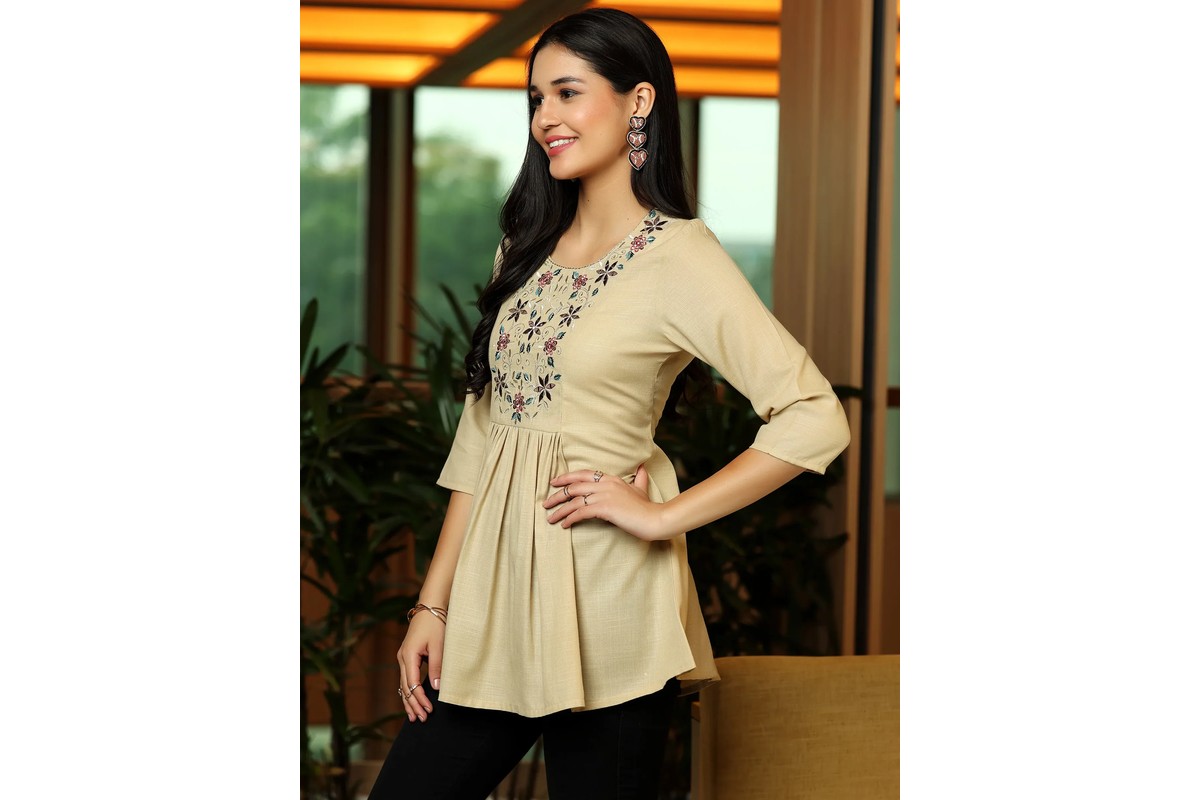
The Beige Cotton-Blend A-Line Kurti with Detailed Yoke at ₹99 is described as an A-line that flares gently from the waist. A flare gives room below the waist. It does nothing for a chest or shoulder that is too small. A two piece set behaves differently, because the trousers have their own fit. The Printed Kurta Set with Straight Pants at ₹99 is one Size choice covering the top and the pants. Its photos show more than one cut, and the page does not say how the waist fastens, so check both pieces against clothes you own as soon as the parcel arrives.

Men’s sizing follows the same method
For shirts, measure a shirt you wear: flat chest doubled, shoulder seam to seam, sleeve from shoulder to cuff, and the length from the base of the collar to the hem. For trousers and jeans, measure a pair you own flat across the waistband and double it, then take the inseam from crotch seam to hem.
A set changes the decision. The Men’s Check Shirt and Denim Jeans Set at ₹149 has one Size dropdown covering both pieces, so you cannot pick a larger shirt and smaller jeans. If you wear different letters on top and bottom, decide which piece matters more to get right.
Buying for someone else
If you cannot measure, lean on shapes that forgive. A-line, flared, wrap and anything with a tie at the waist covers a wide range of bodies. Oversized shirts work on more people than fitted ones. Accessories sidestep the question completely.
Avoid guessing on anything fitted through the waist, and avoid buying two sizes with a plan to return one, because the return courier cost falls on you and eats the saving quickly.
If it still arrives wrong
You have seven days from delivery to return an unused item in its original packing, and the refund covers the product price. The published policy does not describe a size exchange, so ask the shop whether one is possible. If it is not, a size change means returning the first piece and placing a new order. Factor that round trip into when you order, not into whether you order.
If you want to see how this plays out across a full outfit, kurti and palazzo sets for Diwali week covers matching two pieces, and how a ready to wear saree works explains the one category where the sizing question changes shape entirely. The full Women’s Ethnic Wear range is the place to apply the measurements once you have them.

Frequently asked questions
Lay it flat, do up any buttons, and measure straight across from underarm seam to underarm seam. Double that figure for the garment chest. Then take the shoulder seam to seam, the length from shoulder to hem, and the sleeve.
No rule fits every piece. Ask the shop for the garment measurements of both sizes and compare them with a garment you own. Without those, either choice is a guess. A loose piece can sometimes be taken in; a tight one often cannot be let out.
It depends on the cloth and how it was finished, and the product pages do not give a figure. Follow the care label on the garment when it arrives, and avoid a size that only just fits.
No. Letter sizes are not standardised across Indian clothing, and the cut changes how a size feels. Use the seller’s measurements where you can get them, and the shape in the photographs as well as the letter.
The published return policy covers returns and refunds and does not describe a size exchange. Ask the shop whether one is possible. If not, return the item within seven days of delivery, unused and in its original packing, and place a fresh order for the size you want.