
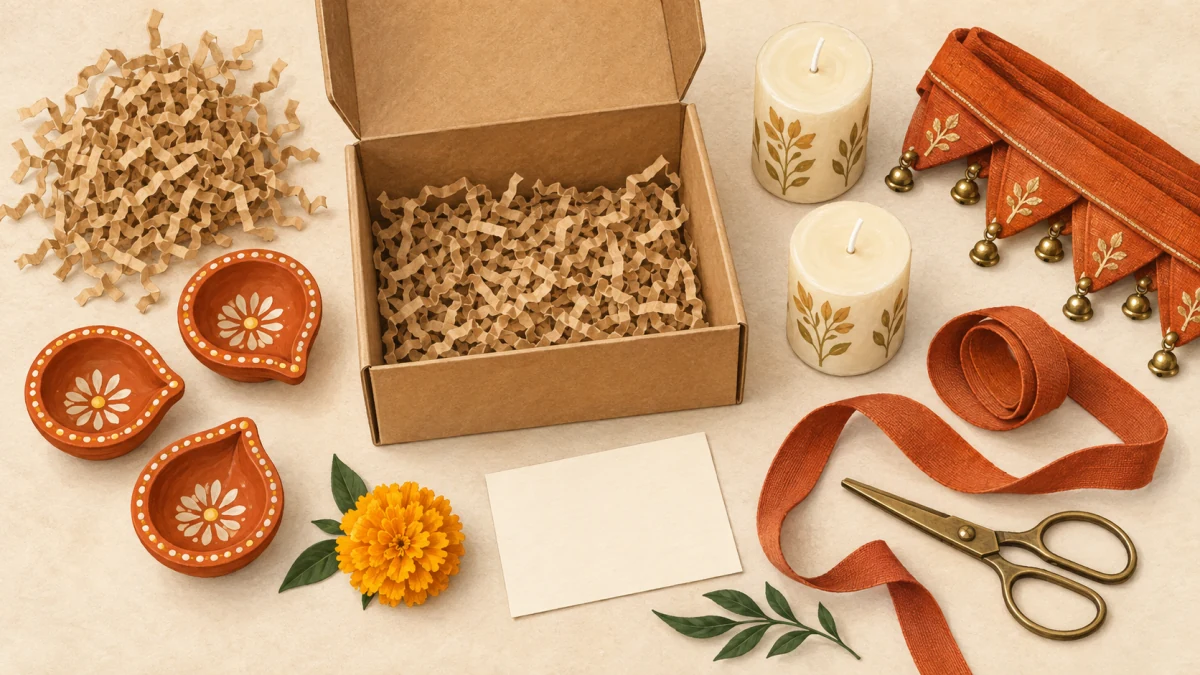
A hamper you put together yourself costs less than a ready-made one, suits the person exactly, and makes it obvious that you gave up an evening for it. Done carelessly, it also turns up as a box of chipped diyas resting on squashed ladoos.
The method below works on a dining table with nothing more than scissors, tape and a free evening. Expect the first hamper to take about an hour. After that, each one goes much faster, because the decisions are already made.
Step 1: Decide the theme
A hamper with a theme looks planned. One without a theme looks like someone emptied a shopping bag into a box. Pick one of these, or make up your own:
- The puja evening. Everything for Lakshmi puja: diyas, wicks, incense, a small puja kit, a sweet for the offering.
- The doorway. A toran, Shubh-Labh hangings, a rangoli set, tealights and holders.
- The table. Dry fruits, one good sweet, tea, and a brass tealight holder for the centre.
- The balcony. String lights, a lantern, tealights in glass holders.
- The new home. Puja kit, thali set, brass diya, toran.
The theme also settles the “what else should I add?” question. If it does not fit the theme, it stays out.
Step 2: Choose five items, not ten
Five things fill a box without cramming it. A good hamper has:
- One anchor. The biggest or most valuable piece, at the back or in the centre. A brass diya, a lantern, a large jar.
- One consumable. Something that gets used up: candles, sweets or dry fruits. It is usually the first thing opened.
- One decorative piece. A toran, a rangoli piece, a small hanging.
- One practical item. Wicks, tealights, incense, camphor.
- One small surprise. A marigold, a handwritten card, a silver coin if you are giving it on Dhanteras, a small packet of good elaichi.
Put most of the money into the anchor and the consumable. The other three can be modest.
If you would rather buy the pieces than gather them from around the house, the Diyas & Lights, Home Decor and Puja Essentials categories line up with the roles above.
Step 3: Find the right box
The box decides whether the hamper looks generous or padded out.
Size: the contents should come up to the rim, with no more than a finger’s width of filler around them. Measure the anchor first, then pick the box.
Type:
- A rigid two-piece box (separate lid and base) is the classic. Packaging shops in most wholesale markets, from Sadar Bazaar in Delhi to Begum Bazaar in Hyderabad, sell them from about ₹60.
- A kraft tray with a clear lid shows off the contents and suits anything you want seen at a glance.
- A cane or bamboo basket looks handmade and is lovely for a gift you deliver yourself, but it does not survive a courier well.
- A reusable tin or steel dabba turns the box into part of the gift.
Avoid: boxes with cellophane windows that tear, glossy printed boxes carrying another brand’s name, and anything so big that the contents slide about.
Step 4: Filler that looks good and costs little
Filler holds things in place and hides the bottom of the box. Good options:
- Shredded kraft paper from a packaging shop, around ₹100 for a big bag.
- Crumpled tissue in one colour, not three.
- Dried marigold petals across the top layer. Real, festive, and free if you already bought flowers for the door.
- Coloured rice or wood shavings for a rustic look.
Skip thermocol beads, which stick to everything and cannot be disposed of responsibly, and shiny plastic grass.
Step 5: Arrange for height
People see a hamper from above and from the front. Build it in three levels:
- Back row, tallest: the anchor and any jar or bottle, standing upright.
- Middle: the consumable and the decorative piece, angled to lean on the back row.
- Front, lowest: wicks, incense, tealights and the card.
If everything is roughly the same height, raise the back row on a small upturned box or a rolled-up newspaper. When the lid comes off, every item should be visible.
Step 6: Pack so it survives
This is the step most people skip.
Diyas and anything clay or glass: wrap each piece separately in paper or bubble wrap, then put the set in a small box or a zip pouch inside the hamper. Loose diyas knock against each other and chip.
Sweets: if you are including them, buy them in a sealed tray or lidded box and do not open it. Home-made sweets go in a lidded food container, then a paper sleeve. Sweets should never sit directly on filler.
Dry fruits: in a jar or a resealable pouch, never an open packet.
Brass and metal: wrap in tissue so they do not scratch anything else.
Incense: keep it in its packet. The smell gets into everything it touches.
The card: in an envelope, on top, so it is the first thing seen.
If the hamper is going by courier, put the finished box inside a corrugated outer carton with cushioning on all six sides. If you are delivering it by hand, a cloth bag or a cloth tied into a potli is enough.
Step 7: Close, tie, label
- Put the lid on and tie it with ribbon, jute cord or a strip of fabric. One colour.
- Tuck one fresh thing under the tie: a marigold, a mango leaf, a sprig of tulsi.
- If you are making several, add a small tag with each person’s name. It saves a mix-up at the door.
- For a courier hamper, the address label goes on the outer carton, never on the gift box itself.
Three example hampers by budget
About ₹600, the doorway:
- 12 painted clay diyas (₹250)
- 25 ghee wicks (₹100, split from a 100-pack across several hampers)
- Small fabric toran (₹200)
- Kraft box and filler (₹50)
About ₹1,000, the puja evening:
- Brass tealight diya (₹350)
- 250 g motichoor ladoo, sealed (₹220)
- Dhoop cones with holder (₹200)
- Puja basics: roli, akshat, moli, camphor (₹150)
- Box, filler, card and ribbon (₹100)
About ₹2,400, the new home:
- Brass diya on a stand (₹600)
- Steel thali set (₹550)
- 500 g kaju katli, sealed (₹650)
- Fabric toran (₹450)
- Rigid box, filler and card (₹150)
These prices are rough market figures and will vary by city. The point is the proportion: most of the money in two or three items, very little in the packaging.
Common mistakes
- Too many small items. Ten small things look like clutter. Five look like a gift.
- Open sweets. Unsealed sweets touch the filler, pick up smells and leave ghee marks on the card.
- Loose diyas. Half of them arrive chipped.
- The wrong size box. Too big and everything slides; too small and the lid will not shut.
- No card. By the time the hamper reaches the kitchen, nobody remembers who sent it.
When to buy ready-made instead
If you are making more than ten, or sending them to another city, the hours and the courier risk start to add up, and a ready-made hamper can be the better use of your evening. If it is going a long way, choose contents that will not spoil in transit. Our Gift Hampers contain only diyas, candles, decor and a card, packed in a basket or gift box. For what to include at each price and what it should cost, see Diwali gifts between ₹500 and ₹2,000.