
For a lot of Indian households, Diwali is the most expensive week of the year, and the one they plan least. The money goes out in a rush of small decisions in the last ten days, and the real total only becomes clear in December, when the credit card statement or the UPI history finally adds it up.
This is a planning method, not financial advice. It gives the seven categories where Diwali money goes, realistic ranges for each, a worksheet to fill in, the places where budgets usually leak, and a timeline that spreads the spending over six weeks so no single week hurts.
The seven categories
Every Diwali expense fits in one of these:
- Cleaning and repairs. Deep cleaning supplies, a painter or cleaner if hired, small repairs, replacing the worn things you notice while cleaning.
- Lamps and lighting. Diyas, wicks, oil, a brass lamp, string lights, candles, lanterns.
- Decor. Toran, rangoli materials, flowers, hangings, anything for the door and the rooms.
- Puja. Idols, samagri, thali, flowers, fruit, offerings.
- Food. Sweets, savouries, dry fruits, the festive meals, the extra groceries for guests.
- Gifts. For family, neighbours, staff, colleagues, clients; the staff bonus.
- Clothes, travel and extras. New clothes, travel home, fireworks if used, eating out, entertainment.
Most people track only 5 and 6 and are surprised by 1 and 7.
Realistic ranges
These are ranges for a household that is neither frugal nor lavish, in a city, in 2026. Adjust for your own situation.
| Category | Small household (1–2 people, flat) | Medium (family of 4) | Large (joint family, house, hosting) |
|---|---|---|---|
| Cleaning and repairs | ₹500 – ₹2,000 | ₹1,500 – ₹5,000 | ₹3,000 – ₹15,000 |
| Lamps and lighting | ₹800 – ₹2,000 | ₹1,500 – ₹3,500 | ₹3,000 – ₹8,000 |
| Decor | ₹500 – ₹1,500 | ₹1,000 – ₹3,000 | ₹2,500 – ₹8,000 |
| Puja | ₹500 – ₹1,200 | ₹800 – ₹2,000 | ₹1,500 – ₹5,000 |
| Food | ₹1,500 – ₹3,000 | ₹3,000 – ₹7,000 | ₹8,000 – ₹25,000 |
| Gifts (incl. staff bonus) | ₹2,000 – ₹6,000 | ₹5,000 – ₹15,000 | ₹15,000 – ₹50,000 |
| Clothes, travel, extras | ₹2,000 – ₹8,000 | ₹5,000 – ₹20,000 | ₹10,000 – ₹50,000 |
| Total | ₹7,800 – ₹23,700 | ₹17,800 – ₹55,500 | ₹43,000 – ₹161,000 |
The lamps and decor lines are the ones where a first-year purchase of reusable items (a brass lamp, a fabric toran, string lights, a rangoli set) pushes the number up once and pulls it down every year after. See the lighting guide and the small-flat decor plan for what that first-year kit costs.
The worksheet
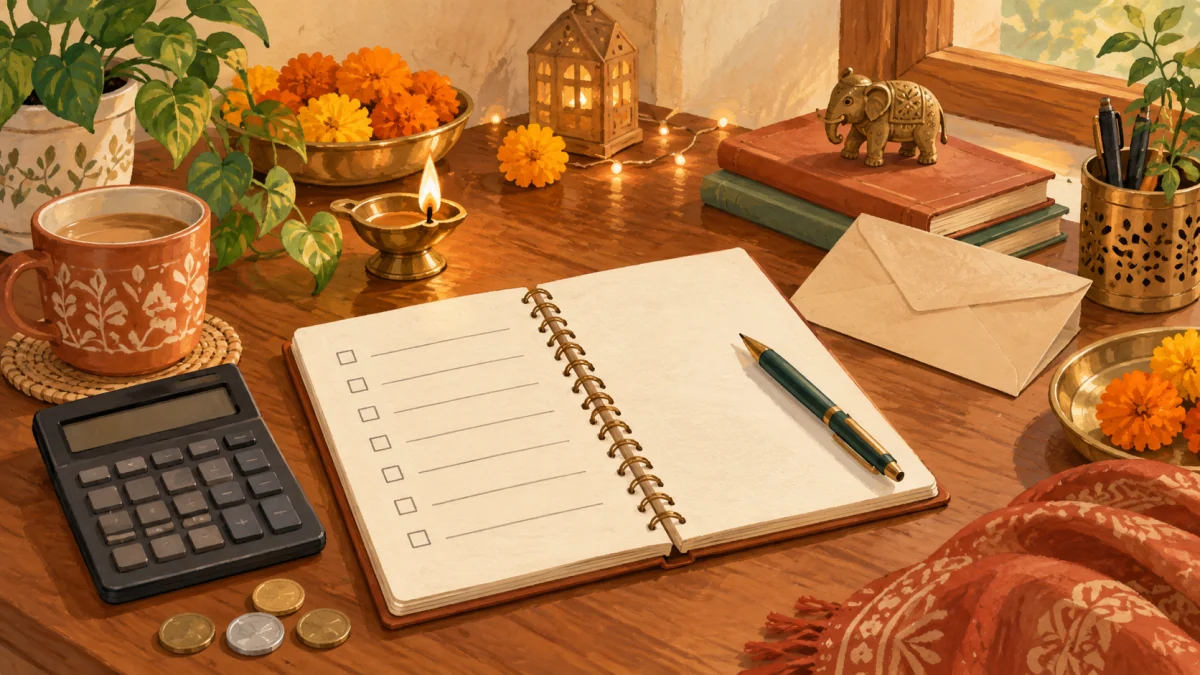
Copy this into a notebook or a phone note. Fill the “plan” column first, in one sitting, before buying anything. Fill “actual” as you go.
| Category | Plan | Actual | Notes |
|---|---|---|---|
| 1 Cleaning and repairs | |||
| 2 Lamps and lighting | |||
| 3 Decor | |||
| 4 Puja | |||
| 5 Food | |||
| 6 Gifts: family | |||
| 6 Gifts: neighbours and friends | |||
| 6 Gifts: staff and bonus | |||
| 6 Gifts: work and clients | |||
| 7 Clothes | |||
| 7 Travel | |||
| 7 Fireworks and extras | |||
| Total |
Two rules for the plan column. First, write the total you can actually afford at the bottom before filling the rows, and make the rows add up to it, not the other way round. Second, put a number in every row, even zero. A blank row is where money goes without being counted.
Where budgets leak
Gifts bought one at a time. Twenty small gifts bought over ten trips cost far more than twenty bought at once. List every recipient first (the family gifting guide and the neighbours and staff guide help), set a per-person figure, and buy in one or two rounds.
Sweets in the last three days. Prices at halwais rise and quality falls in the final rush. Buy or make earlier; buy fresh only what is for the puja and the day itself.
Decor that gets used once. Plastic garlands, disposable rangoli stickers, cheap lights that die by day three. The reusable version costs more this year and nothing next year.
“While we are at it.” Cleaning reveals a broken tap, a torn curtain, a peeling wall. Some of it must be fixed; much of it can wait for January. Decide in advance which.
Fireworks. Historically the single largest discretionary spend in many households, and the one with the least to show for it the next morning. The eco-friendly guide makes the case for cutting it; the budget makes it for you.
Travel booked late. Train and flight prices for Diwali week are highest in the last month. If you are going home, book in September.
Round numbers given as bonus. The staff bonus is often decided on the day. Decide it in the worksheet, with the amount, so it is neither less than it should be nor more than you planned.
A six-week timeline
Spending spread over six weeks is less painful and cheaper, because you buy when prices are normal.
Week 6 (six weeks before Diwali): fill the worksheet. Book travel. Decide the gift list and per-person amounts. Decide on fireworks: yes with a fixed sum, or no.
Week 5: buy reusable lighting and decor (brass lamp, string lights, toran, rangoli set) while stock and prices are normal. Buy the puja kit and thali if needed. Start cleaning; buy cleaning supplies. The cleaning timeline runs from here.
Week 4: order any gifts going by courier to other cities. Buy dry goods for sweets and savouries (ghee, flour, sugar, nuts). Buy clothes if buying.
Week 3: buy diyas, wicks, oil, candles. Make and store savouries that keep (chakli, mathri, chivda). Buy staff gifts; withdraw bonus cash.
Week 2: buy local gifts for neighbours and family. Make sweets that keep two weeks or more. Finish cleaning.
Week 1: fresh sweets for the puja and the day; flowers, fruit, and the fresh puja items on Dhanteras and the day itself. This week should be the cheapest, not the most expensive.
Reducing the total without reducing the festival
If the worksheet total is more than you can afford, cut in this order:
- Fireworks: to zero or a small fixed sum.
- Clothes: one new item per person, not a full outfit; or none for adults.
- Decor: skip disposables; keep the reusables you already own.
- Food: fewer varieties, made at home; buy dry fruits in bulk rather than in gift packs.
- Gifts: reduce the count before reducing the per-gift amount for staff and close family.
- Travel: the hardest to cut, and often the most important; protect it.
Do not cut: the staff bonus, the puja essentials, the lamps. These are the festival.
After Diwali
Spend ten minutes in the week after filling the “actual” column. Note what was unused (that box of decor, the extra sweets) and what ran out. Next year’s worksheet starts from this one, and the second year is always cheaper.
The reusable items that make the second year cheaper, lamps, torans, rangoli sets and string lights, are in Diyas & Lights and Home Decor, and the puja kit that removes a dozen small purchases is in Puja Essentials.