
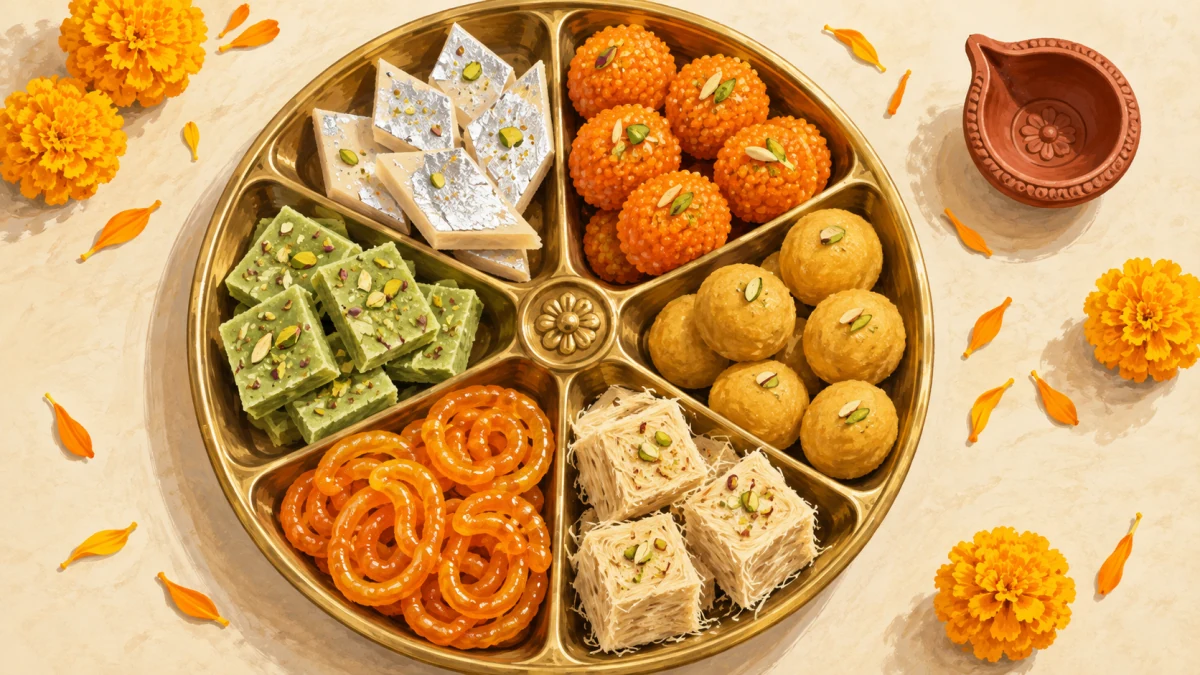
Sweets are the currency of Diwali. They are the offering at the puja, the gift to the neighbour, the thing on the table when anyone walks in. Most families have a fixed list of the ones that must be there, and most of those lists overlap.
This guide goes through the classics: what each one is made of, roughly where it comes from, why it became a Diwali sweet, and how to tell a good one from a bad one. It ends with a note on which sweets travel and which do not, for anyone sending a box across the country.
Kaju katli
What it is: cashew nuts ground to a paste, cooked with sugar and a little ghee, rolled thin, cut into diamonds and finished with silver leaf (varq).
Where it comes from: the story usually told is that it originated in the Mughal kitchens, where cashews (brought to India by the Portuguese in the sixteenth century) met the Persian tradition of nut confections. It became a north Indian sweet-shop staple and, in the last few decades, the single most gifted Diwali sweet in the country.
Why it is a Diwali sweet: it keeps for ten days or more without refrigeration, it is not sticky, it looks expensive, and everybody likes it.
A good one: smooth, not grainy; thin, about 5 mm; firm enough to pick up, soft enough to yield; a clean cashew taste with cardamom, not a sugar hit. Grainy or crumbly kaju katli was overcooked or made with too much sugar. The best ones are made a day or two before you buy them, so ask the shop when the batch was made.
Motichoor ladoo
What it is: tiny droplets of gram-flour (besan) batter fried in ghee, soaked in sugar syrup with cardamom and saffron, and pressed into balls while warm. “Motichoor” means crushed pearls; the boondi is much finer than in a regular boondi ladoo.
Where it comes from: north India, particularly Uttar Pradesh and Bihar, with a long history as a temple and wedding sweet.
Why it is a Diwali sweet: it is the classic offering to Lakshmi and Ganesh; ladoos are Ganesh’s favourite in every telling. It is also generous-looking and shares easily.
A good one: soft, breaks apart into individual grains on the tongue, moist with ghee but not oily, with a distinct saffron note. A hard or dry ladoo is stale or was pressed too tightly. Buy it the day before or the morning of, never a week ahead.
Besan ladoo
What it is: gram flour roasted slowly in ghee until it smells nutty, mixed with powdered sugar and cardamom, and rolled into balls. No syrup, no frying.
Where it comes from: everywhere in north and west India; it is the home-kitchen ladoo.
Why it is a Diwali sweet: it keeps for weeks, it is made at home in one pan, and it is what grandmothers make.
A good one: grainy but not raw-tasting, the besan roasted until deep golden, with visible ghee sheen. Under-roasted besan ladoo tastes of raw flour. It is the easiest of these to make; the easy recipes article has it.
Barfi
What it is: a dense, fudge-like sweet made by cooking milk solids (khoya or mawa), or a nut paste, with sugar until it sets, then cutting into squares. Plain (milk), pista, badam (almond), coconut, chocolate, and the two-coloured kinds all belong to the family. Kaju katli is technically a cashew barfi.
Where it comes from: the word is from Persian barf, snow, for its whiteness. It spread across north India from the Mughal period and every region has a version.
Why it is a Diwali sweet: it keeps well, cuts neatly for boxes, and comes in enough varieties to fill an assortment.
A good one: dense and smooth, not chalky, not weeping syrup. Milk barfi should taste of reduced milk, with a slight caramel edge.
Jalebi
What it is: a fermented batter of refined flour, piped in spirals into hot ghee or oil, then dipped in saffron sugar syrup. Crisp outside, syrupy inside.
Where it comes from: a very old sweet with cousins across the Middle East and Central Asia (zalabiya, zulbia); in India it is recorded in medieval texts. It is a north and west Indian street sweet more than a box sweet.
Why it is a Diwali sweet: it is a celebration sweet everywhere; at Diwali it is eaten fresh, often for breakfast, in many north Indian homes, with milk or rabri.
A good one: thin, crisp, fried just before eating, syrup absorbed but not dripping. Jalebi does not travel and does not keep. Buy it hot, eat it hot.
Soan papdi
What it is: a flaky, cube-shaped sweet made by pulling a cooked sugar and gram-flour dough into thousands of fine strands, layered with ghee and cardamom, often with pistachio on top.
Where it comes from: debated between Maharashtra, Gujarat, Rajasthan and Uttar Pradesh. It became a nationally boxed sweet once factories learned to make it in bulk.
Why it is a Diwali sweet: it is cheap, keeps for months, and comes in a box. It is also the most re-gifted sweet in India, a running joke every festival season.
A good one: light, melting, with distinct flaky layers and a fresh ghee taste. A stale one is compressed and tastes of cardboard. Fresh hand-pulled soan papdi from a good shop is a different sweet from the boxed kind.
Kheel and batasha
What it is: puffed rice (kheel) and small disc-shaped sugar drops (batasha), sold together in the market before Diwali.
Where it comes from: north India, especially Uttar Pradesh, Bihar and Delhi.
Why it is a Diwali sweet: it is the traditional offering to Lakshmi in north Indian homes, placed on the altar and distributed as prasad. The puffed rice is the new harvest; the sugar drops are sweetness for the year. In many families this, not any elaborate mithai, is the Diwali prasad.
Gulab jamun
What it is: balls of khoya and a little flour, fried until dark gold and soaked in rose-cardamom sugar syrup.
Where it comes from: Persian-influenced, with the name from gul (rose) and jamun (for the fruit it resembles in colour). Popular across the whole country.
Why it is a Diwali sweet: it is a favourite at every Indian celebration and is served warm at Diwali dinners.
A good one: soft all the way through, syrup fully absorbed, no hard centre. It does not travel by courier; buy or make locally.
Mysore pak
What it is: gram flour, sugar and a great deal of ghee, cooked until it sets into a dense, crumbly or fudgy block, depending on style.
Where it comes from: the kitchens of the Mysore palace, credited to the cook Kakasura Madappa in the early twentieth century.
Why it is a Diwali sweet: in Karnataka and Tamil Nadu it is the Diwali sweet; boxes of it are given the way kaju katli is given in the north. The soft, ghee-rich style keeps about a week.
Regional Diwali sweets worth knowing
- Anarsa (Maharashtra, Bihar): a rice-flour and jaggery disc, fermented, fried and coated in poppy seeds. Made specifically for Diwali.
- Karanji / gujiya (Maharashtra, north India): a crescent pastry filled with coconut, khoya or dry fruits and fried. Gujiya is more associated with Holi in the north but appears at Diwali in the west.
- Shankarpali (Maharashtra, Gujarat): sweet diamonds of fried dough, part of the faral (Diwali snack platter).
- Adhirasam (Tamil Nadu): rice flour and jaggery, fermented and fried; the Tamil Diwali sweet.
- Narkel naru (Bengal): coconut and jaggery ladoos, made for Lakshmi puja.
- Ghevar (Rajasthan): a honeycomb disc of flour and ghee soaked in syrup, more associated with Teej but sold at Diwali.
- Pootharekulu (Andhra Pradesh): paper-thin rice sheets layered with ghee and sugar, from Atreyapuram, a Diwali gift box staple in Hyderabad.
Our article on Diwali across India covers the regional celebrations these belong to.
Which sweets travel
If you are sending a box by courier across the country:
Travel well (7 to 15 days at room temperature): kaju katli, besan ladoo, dry barfis (pista, badam), soan papdi, mysore pak (firm style), dry fruit sweets, anarsa, shankarpali.
Travel with care (5 to 8 days, dispatched early in the week): motichoor ladoo, milk barfi, coconut barfi.
Do not travel: jalebi, gulab jamun, rasgulla, rasmalai, sandesh, anything in syrup or anything that needs a fridge.
So if you are sending sweets to another city, pick from the first list, buy from a shop you trust, and send them early in the week so they are not sitting in a courier hub over Sunday. We do not sell or ship sweets ourselves; this is general advice for whatever you send. For the recipes, see five easy Diwali sweets in under an hour, and for the savoury side of the platter, Diwali snacks: namkeen, chakli and mathri.