
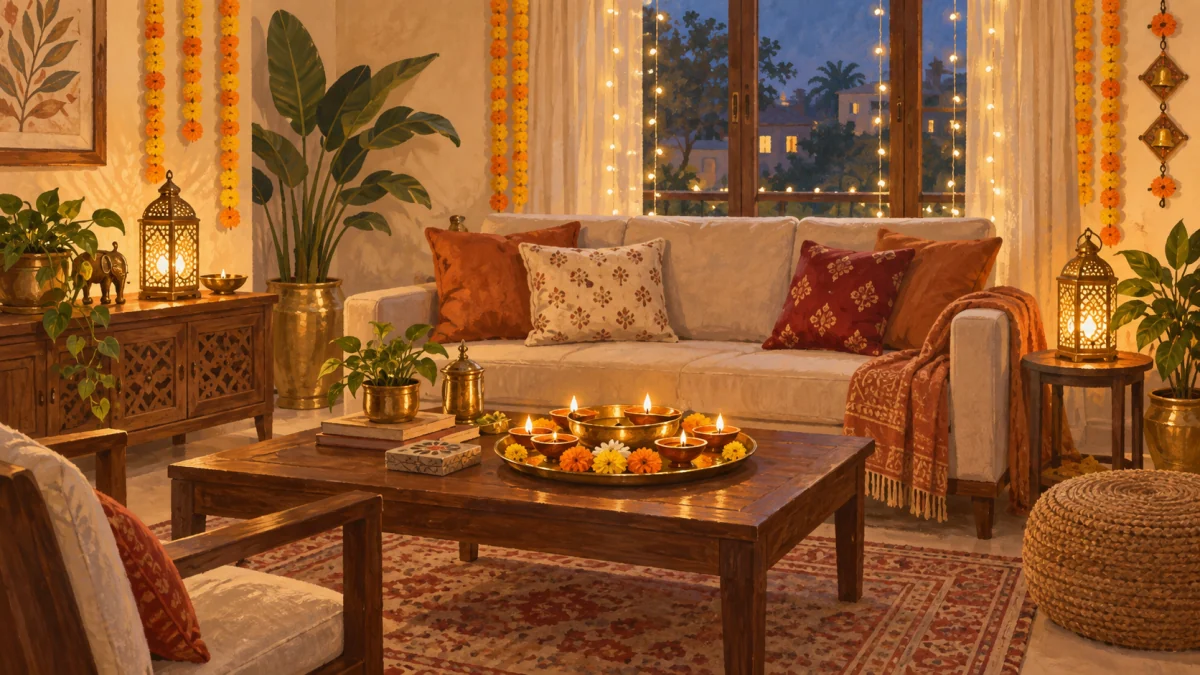
In most homes, Diwali decor ends up in two places: the entrance, because that is what guests see, and the puja corner, because it has to be done. The rest of the house gets whatever energy is left over. That is fine. But a home done room by room, even lightly, feels noticeably different to live in over the five days, and it is less work than it sounds, because each room only needs two or three things.
This guide walks through an ordinary Indian home, say a two-bedroom flat or a small independent house, and for each room suggests what to do first, what to add if you have time, and what to leave alone.
The entrance
The entrance carries the festival. It is where the rangoli goes, where the first diyas are lit, and where Lakshmi is traditionally welcomed in.
Do first:
- A toran across the door. Fresh marigold and mango leaves if you can get them on the day; otherwise a fabric or beaded toran, which lasts all five days and comes out again next year. Torans, wall hangings and entrance decor covers how to hang one.
- A rangoli on the threshold or just inside it. Powder if nobody will be walking over that patch of floor; a ready-made wooden or acrylic set if they will. Easy rangoli designs for beginners has patterns you can finish in under an hour.
- Diyas along the threshold and steps. Odd numbers look better: five or seven along a step, one on each side of the door.
Add if you have time:
- Shubh-Labh hangings on either side of the door frame.
- A pair of lanterns flanking the door, which also shield the flames on a windy evening.
- A small brass bell on the door.
Skip: flashing multicolour lights round the door frame. Warm white, or diyas alone, look far better and do not compete with the rangoli.
The living room
This is where guests sit, so aim for warmth, not a light show.
Do first:
- A cluster of diyas or tealights on the centre table. Three to five brass or clay diyas on a thali or tray, with a few flowers tucked between them. This one arrangement is enough to make the room feel festive.
- Warm-white string lights along one window or one wall. One run, not four. Follow a curtain rod, the edge of a bookshelf or a window frame.
Add if you have time:
- A lantern on a side table, or on the floor next to the sofa.
- Floating candles and flower heads in a wide brass or steel urli, or any shallow bowl.
- Fresh marigold strings along the top of the window, hung from the curtain rod.
- Cushion covers in a festive colour if you already own some. Do not buy new ones for five days.
Skip: decorating every surface. One arrangement per surface, or none at all.
The puja corner or puja room
The one place where decorating is also part of the ritual.
Do first:
- Clean it properly. That is part of the tradition, not just a chore. Our cleaning and preparation timeline fits it into the weeks before.
- Put a fresh cloth on the altar, red or yellow.
- Clean and polish the brass lamp. A good brass diya, such as a brass akhand diya with a glass cover, is the piece that anchors this space.
- Fresh flowers, a garland for the idols or picture, and the thali laid out. The puja thali guide lists what goes on it.
Add if you have time:
- A small rangoli in front of the altar, often a lotus or a swastika.
- A string of warm-white lights along the top of the shelf, kept well away from the flame.
- Small diyas at the four corners of the puja space on the evening.
Skip: anything plastic, and scented candles in this corner. Let incense be the only fragrance here.
The dining table
People will be eating here, so the decor should not take up plate space.
Do first:
- A runner, or a folded dupatta, down the middle.
- One tall piece in the centre: a lantern, a brass lamp or a small vase of marigolds.
- Sweets and dry fruits in bowls or on a thali, not in their shop boxes.
Add if you have time:
- A tealight in a small holder at each place.
- Marigold petals scattered along the runner.
Skip: a big centrepiece that everyone has to lean around to talk.
The balcony or verandah
Seen from the street and from inside the house, this is the place for lights that would be too much indoors.
Do first:
- Warm-white string lights along the railing. One 10 m string covers a standard balcony. Fix it with cable ties, keep the plug indoors, and read the Diwali safety guide before you hang anything.
- Tealights in glass holders on the ledge. Bare diyas blow out in the evening breeze; glass holders fix that.
Add if you have time:
- A lantern or two on the floor.
- A paper or fabric akash kandil, the star lantern you see on balconies across Maharashtra and Gujarat, hung from the ceiling.
- Marigold strings along the railing over the lights.
Skip: electric lights left out in the rain, and anything hanging that a child could lean over the railing to reach.
The kitchen
The kitchen works hardest at Diwali, with the chakli, the ladoos and the endless chai, and it usually gets no decor at all.
Do first:
- Clean it, which is the traditional preparation anyway.
- A small rangoli, or a swastika in kumkum near the stove, as many families do.
- A single diya on the windowsill or near the stove on the evening, kept well away from oil and cloth.
Add if you have time:
- A string of marigolds over the window.
- Sweets and namkeen moved into steel or glass jars on the counter, so the kitchen looks well stocked.
Bedrooms
Bedrooms need very little. A string of lights along the headboard or the window, a single diya on the dresser on the evening, fresh bedsheets. A child’s room can have a small rangoli set on the floor and battery tealights they can “light” themselves.
Bathrooms
A tealight in a holder and a fresh towel. Honestly, that is all.
Three principles that make any room look right
- One light source per surface. A cluster on the table, a run along the window, a lantern on the floor. Not all three on every surface.
- Warm light only. Diyas, candles and warm-white LEDs share the same glow. Cool white or multicolour lights clash with everything else. The Diwali lighting guide explains the options.
- Fresh flowers once, on the day. Marigold strings from the market on Diwali morning change a room for about ₹100. Buy them for the day, not the week, because they wilt fast.
A shopping list for a two-bedroom home
Starting from scratch, this covers every room above:
| Item | Quantity | Where it goes |
|---|---|---|
| Clay diyas, painted | 24 (two sets of 12) | Entrance, puja, living room, kitchen |
| Ghee wicks | 100 | All diyas, five evenings |
| Brass diya on stand | 1 | Puja corner |
| Tealights with glass holders | 50 + 6 holders | Balcony, dining table, bathrooms |
| Warm-white string lights, 10 m | 2 | Living room window, balcony railing |
| Fabric toran | 1 | Main door |
| Ready-made rangoli set | 1 | Entrance or living room |
| Lantern | 1 or 2 | Entrance or balcony |
| Marigold strings | 4 to 6 | Bought fresh on the day |
You will find diyas, string lights, torans and rangoli sets in Diyas & Lights and Home Decor. If you live in a small or rented flat, our guide to Diwali decor in a small apartment trims this list down further.