
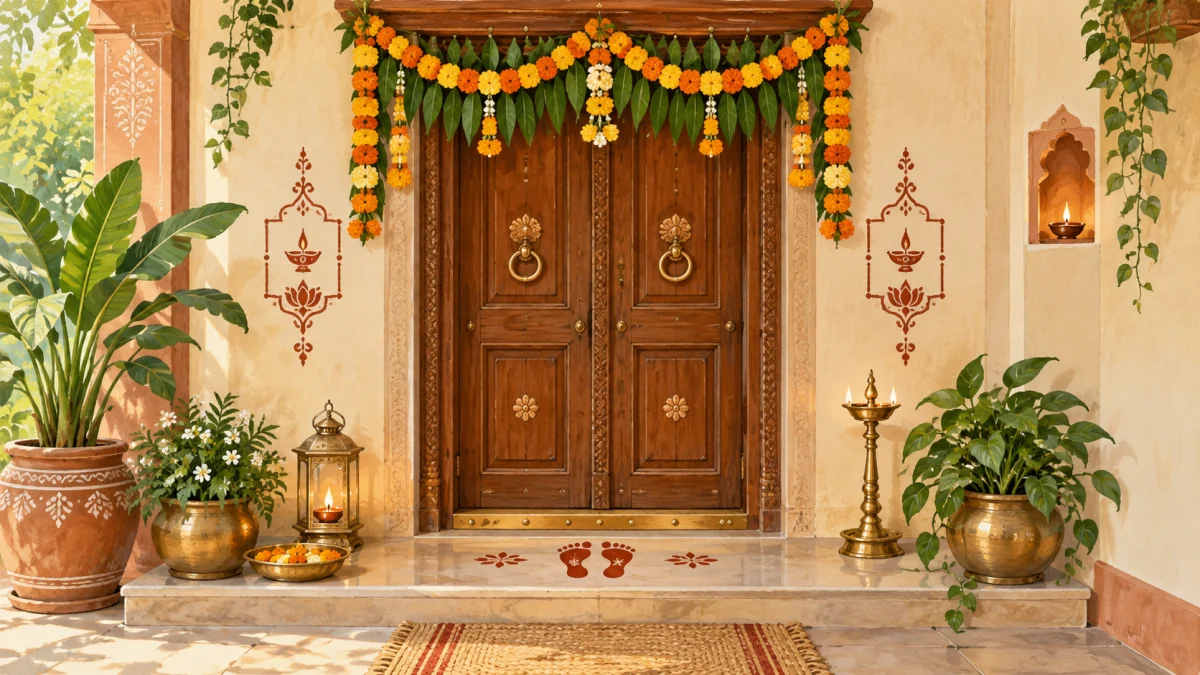
Diwali starts at the front door. Before a single diya is lit inside, the doorway is swept, washed, decorated and made welcoming. The idea at the heart of the festival is that Lakshmi visits homes on the new-moon night and comes into the ones that are ready for her.
Everything that goes on and around the door has a name, a meaning and a rough order. This guide explains each piece, compares fresh and fabric versions, and answers the question every flat-dweller asks: how do you hang all this on a modern door without a single nail?
The toran (bandhanwar)
A toran is the string of leaves or flowers hung across the top of the doorway. In the north it is often called a bandhanwar; in Tamil Nadu and Kerala, a thoranam. It marks the threshold as auspicious and, in the old explanation, cleanses the air coming into the house.
Mango leaves are the traditional material across most of India. They stay green for several days after cutting, they are linked with prosperity and with Lakshmi, and they were once simply what every village had to hand. A mango-leaf toran is whole leaves threaded onto a string, stem end up, packed close so they overlap.
Marigolds (genda) are the flower of Diwali. Their orange and yellow are the festival’s colours, they are cheap and plentiful in October and November, and they cope with heat better than most flowers. A marigold toran is flower heads threaded on a string, sometimes alternating with mango leaves.
Ashoka, neem and banana leaves are used in some regions, on their own or mixed with mango.
Fresh or fabric?
Fresh is the real thing. It costs ₹30 to ₹100 at any market on Diwali morning, smells green and looks alive. It also wilts within a couple of days in most Indian weather, so over five days of festival you will replace it once or twice.
Fabric and beaded torans use cloth, foam or bead marigolds and printed or embroidered leaves on a cord. A good one looks convincing from a metre away, lasts the whole festival and every one after it, and folds into a drawer. Our handmade beaded door toran, with beads, bells and marigold motifs, is made to be reused year after year.
The practical answer is both: a reusable toran up from Dhanteras, and a fresh mango-leaf or marigold string added over it on Diwali morning.
How to hang a toran
A toran hangs across the top of the door frame with a gentle dip in the middle.
- Two hooks: removable adhesive hooks rated for about 1 kg each, placed just above the corners of the frame. The peel-off kind leaves no mark on painted wood or walls.
- The string trick: tie the toran’s loops to a length of cotton string, run the string over the top of the door and shut the door on it. No hooks, no glue, and it works on any door that opens inward.
- Nails, if you own the house: two small nails just above the frame, left in from one year to the next.
If your door opens outward onto a corridor, do not hang the toran on the door itself; it will snag every time. Hang it from the frame.
Shubh and Labh
Shubh (auspicious) and Labh (gain, profit) are written on either side of the main door. The custom is tied to Lakshmi puja and to the tradition of opening new account books at Diwali, which is still followed in trading families from Gujarat to Kolkata. In some traditions Shubh and Labh are the sons of Ganesha and companions of Lakshmi; in others they are simply the two blessings a household asks for.
Traditional: written in kumkum, or rice paste mixed with haldi, with Shubh on the left as you face the door from outside and Labh on the right, and a swastika between or above them. Repainted every year.
Hanging pair: wooden or fabric plaques carrying the words, hung from the frame or the door handle. Handy in rented homes where painting on the door is not an option.
The swastika
The swastika is an ancient Indian symbol of well-being. At Diwali it is drawn on the door, in the puja space, in account books and often in the kitchen, in kumkum or rice paste or as part of a rangoli, with its arms turning clockwise. Keep it small and neat. It is a mark, not a decoration.
(Readers outside India sometimes ask about this symbol. Its use in India predates its misuse in twentieth-century Europe by thousands of years, and it carries no such meaning here.)
Lakshmi’s footprints
Small pairs of footprints walking from the doorstep into the house stand for Lakshmi coming in. There are several ways to make them:
- Rice paste or kumkum, using a stencil or a potato cut to shape, on the step and the floor inside.
- Stick-on footprints in red or gold, sold in every market in Diwali week, which peel off once the festival is over.
- Rangoli powder shaken through a stencil.
They should point inward, never outward, and end at the puja space.
Bells
A small brass bell tied to the door or the frame with red thread is common in many homes. Part of it is practical, because it rings when the door opens, and part is symbolic: sound is said to clear a space. It is a nice small touch that can stay up all year.
Wall hangings beside the door
Beyond the essentials, the wall on each side of the door can take:
- A pair of lanterns, on the floor or hung from hooks.
- Strings of small bells or ghungroo.
- An akash kandil, the star lantern of Maharashtra and Gujarat, hung from the ceiling or a bracket.
- A small framed picture or a pichwai-style hanging, if the entrance is under cover.
Stick to one or two of these. The door should stay the focus.
The rangoli
The rangoli sits on the floor at the threshold or just inside it, and it deserves a guide of its own. Rangoli designs explained covers the meanings and regional styles; easy rangoli designs for beginners has patterns to start with. For a flat with a shared corridor, a reusable rangoli set laid on a mat solves the problem neatly.
The diyas
Last of all, on the evening, come the diyas: one on each side of the door, a row along the threshold or steps and, in many families, one at every corner of the outer wall. Use odd numbers, evenly spaced. The lighting guide compares clay, brass and tealights, and the safety guide covers keeping flames well clear of the toran above.
The order, on the day
If you are doing the whole entrance on Diwali morning:
- Sweep and wash the threshold and step.
- Hang the toran (fresh over the reusable one if you have both).
- Draw Shubh-Labh and the swastika.
- Make the rangoli.
- Add footprints leading in.
- Set out the diyas unlit, wicks in place, oil ready.
- Light them at dusk, after the Lakshmi puja lamp inside has been lit.
What to avoid
- Plastic torans. They look like plastic and never break down. Go for fabric, beads or fresh.
- Flashing lights round the frame. They drown out everything traditional.
- Diyas right under a fresh toran. Mango leaves dry out and catch fire. Keep flames at least 30 cm below the leaves.
- Blocking a shared corridor. In an apartment, keep the decor to the door and the mat.
Torans, rangoli sets and other entrance pieces are in Home Decor. For the rest of the house, see Diwali home decor for every room.