
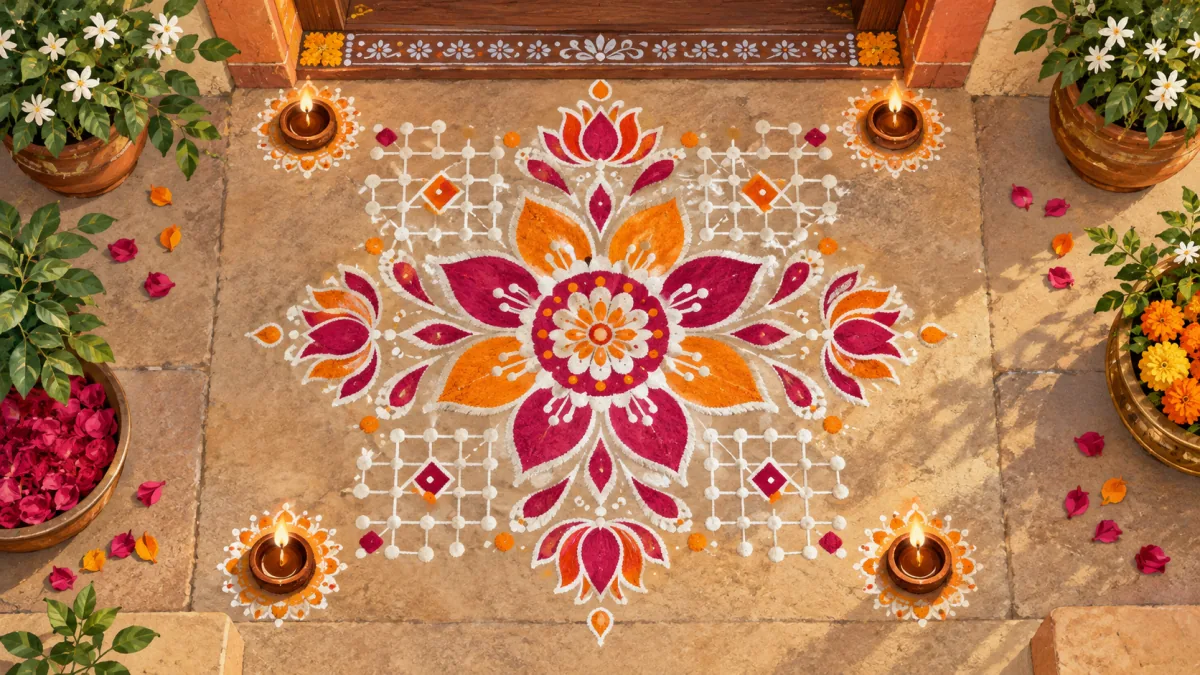
Every morning across much of India, someone bends at a doorway and draws a pattern on the ground in rice flour or coloured powder. By evening the milkman, the school bus rush and the neighbour’s scooter have scuffed it; the next morning it is drawn again. At Diwali the pattern gets bigger and brighter and is lit with diyas, but the habit behind it is old, and it is daily.
This guide explains what rangoli is, where it comes from, how it differs from region to region, what the common patterns mean, and what it is made of. If you want to draw one, easy rangoli designs for beginners is the practical companion.
What rangoli is
Rangoli is floor art: a design drawn or laid on the ground at the threshold of a home, temple or courtyard, using powder, flour, flowers or other loose materials. The word is usually traced to Sanskrit rangavalli, a row or creeper of colours. It is made to be temporary. It is drawn in the morning as an act of welcome and protection, walked over, and drawn again.
It is not simply decoration. In the traditional understanding, the rangoli at the door invites the goddess Lakshmi and marks the home as cared for and awake. Rice flour designs also feed ants and birds, which many families cite as the original point: the first act of the day is to give food to the smallest creatures.
Where it comes from
Floor drawing appears in Indian literature and painting going back well over a thousand years; there are references in the Kamasutra‘s list of arts and in medieval texts on painting, and the practice is much older than the references. Regional forms developed largely separately, which is why the same idea has half a dozen names and very different looks across the country.
Regional styles
Kolam (Tamil Nadu). Drawn daily in white rice flour, kolam is built on a grid of dots (pulli). Lines loop around the dots without lifting, forming continuous, often symmetrical curves. Mathematicians have studied kolam for its properties; a true kolam is a single unbroken line or a small set of them. Colour is added at festivals. At Diwali and during the month of Margazhi, kolams grow large and elaborate.
Muggu (Andhra Pradesh and Telangana). Close cousin of kolam, also dot-based, drawn in rice flour or chalk powder. At Sankranti the muggu is at its most elaborate, with cow-dung balls topped with pumpkin flowers placed on it. For Diwali, families in Hyderabad and across Telangana draw muggulu at the door with coloured powders added.
Rangoli (Maharashtra, Gujarat, Karnataka, north India). The freehand, coloured form most people picture: lotus flowers, peacocks, geometric mandalas, filled with bright powders. In Maharashtra a sanskar bharati style uses sweeping curves filled with graded colour. In Gujarat the same art is called sathiya when it is the swastika-based form drawn at the door.
Alpana (Bengal). Drawn in a paste of rice flour and water, applied with a finger or a cloth wick, in white on the floor. Alpana designs are flowing and often depict lotus, fish, conch shells and the footprints of Lakshmi. Drawn for Lakshmi puja and Durga puja, and for family rituals.
Mandana (Rajasthan). Drawn on walls and floors in white chalk or lime paste over a base of red ochre or cow dung. Geometric and figurative, with peacocks, elephants and tigers. Traditionally done by women of the household for festivals and weddings.
Aripana (Bihar), Chowkpurana (Uttar Pradesh), Jhoti (Odisha). Related forms, each with local motifs, mostly in white rice paste, drawn for specific rituals.
Pookalam (Kerala). Not for Diwali but worth naming: the flower-carpet of Onam, built in concentric rings of petals over ten days.
Across all of these the common thread is the threshold, the morning, and the temporary material.
What the patterns mean
Rangoli motifs are not random. The common ones, roughly:
Lotus. Lakshmi’s flower, and the most common Diwali rangoli. Represents purity, prosperity and the goddess herself. Usually at the centre.
Swastika. An ancient mark of well-being, drawn at the door and in the puja space. The arms turn clockwise. It is small and precise, not a large decorative element.
Footprints. Lakshmi’s feet, walking in from the threshold to the puja room. Drawn in pairs, leading inward.
Dot grids and knots (kolam). The continuous line around dots is said to represent the unbroken cycle of life; the grid is order; the whole is a kind of protective net. Kolam patterns are also, less mystically, beautiful mathematics.
Peacock. Associated with Saraswati and with Karttikeya; a symbol of beauty and grace. Common in Maharashtrian and Gujarati rangoli.
Diya. A lamp drawn in the rangoli, or real diyas placed on it. Light over darkness, the whole point of the festival.
Conch, fish, elephant. Auspicious objects from Lakshmi’s iconography and from wedding and puja symbolism.
Geometric mandalas. Concentric circles and symmetrical repeats. Order, wholeness, a centre.
The meanings vary by family and region; what is listed here is the common understanding, not a rulebook.
Materials, traditional and modern
Rice flour. The oldest material and still the daily one in the south. White, fine, edible for ants. Sometimes mixed with a little water into a paste (alpana, aripana).
Coloured powders. Originally from natural sources: turmeric (yellow), kumkum (red), indigo (blue), charcoal (black), dried petals. Today mostly synthetic pigment on a rice-flour or limestone base, sold in packets in every market. Buy from a shop that sells food colours if children will handle it, and avoid glitter powders, which are plastic.
Flowers. Marigold petals, rose petals, chrysanthemums, whole flower heads. Fast, fragrant, and the easiest way to make a large rangoli look full.
Grains and pulses. Rice (often dyed), lentils, split peas, for texture.
Diyas and tealights. Placed on the design to light it at night.
Ready-made. Stencils, stickers, wooden or acrylic sets. Not traditional, entirely practical, especially in flats. A reusable rangoli mat set, four acrylic pieces that fit together into a 24-inch design, goes down in a couple of minutes and wipes clean for next year.
Why it is drawn every morning
The reasons families in Tamil Nadu give for the dawn kolam tend to be some mix of these: it is what we do; it feeds the ants; it welcomes the day; a house without a kolam looks like nobody lives there, or like there has been a death. The last point matters: not drawing one is a signal, so drawing one is a small daily statement that all is well.
At Diwali the daily practice is amplified. The design is larger, coloured, lit, and it stays through the evening because that is when Lakshmi is said to come.
Rangoli and the environment
Two things worth knowing:
- Synthetic powder washed into drains is a small but real pollutant. Rice flour, flowers and natural colours are not. For a large rangoli, flowers and flour do most of the work and the synthetic colour can be used sparingly for outlines.
- Powder on a tiled floor is slippery. Sweep, do not wash, and keep a mat at the edge.
Our eco-friendly Diwali guide has more on materials.
Where to go from here
If you have never drawn one, start with a dot-grid kolam of five by five dots, or a simple lotus with six petals. Easy rangoli designs for beginners walks through both, plus flower and diya rangoli for a fast, forgiving result. For the door of a flat, a reusable set from Home Decor with diyas or candles from Diyas & Lights is the low-effort version that still looks right.